Rhizomes: Cultural Studies in Emerging Knowledge: Issue 41 (2026)
Anonymity and Becoming-Imperceptible on the Lower East Side: Gender and Gentrification in Desperately Seeking Susan
Kyler Chittick
University of Alberta
Abstract: This paper examines Desperately Seeking Susan (1985) through an interdisciplinary lens that integrates Johan Andersson’s concept of “gentrification by genre” with Jackie Stacey’s feminist reading of the film. Andersson highlights how the film commodifies New York City’s bohemianism, introducing it to mainstream audiences while eliding the grittier socioeconomic realities of gentrification. Stacey, on the other hand, underscores the film’s interrogation of female desire and friendship, where feminine identification evolves into an embrace of multiplicity. Building on these frameworks, I argue that the film creates moments of feminist spatial-political resistance by engaging urban transformation as a site for gender subversion. Drawing on Gilles Deleuze and Félix Guattari’s concept of “becoming-imperceptible,” I explore how the city’s transitional state enables female protagonists Roberta (Rosanna Arquette) and Susan (Madonna) to resist fixed identities, slipping between visibility and invisibility. This anonymity destabilizes patriarchal norms by creating ephemeral spaces for feminist agency, even as it remains incompatible with sustained collective action. By synthesizing urban studies with queer and feminist film theory, this analysis situates the film as an exemplary cultural text for negotiating the intersections of gender, urban aesthetics, and the politics of urban space.
Introduction
Cultural geographer Johan Andersson examines how Susan Seidelman’s Desperately Seeking Susan (1985) “grapples with its dual status as corporate commodity and auteurist work of art” (2019: 329). Set in New York City’s East Village and SoHo districts, the film references various bohemian landmarks to authenticate its “subcultural aura” and introduce “downtown Manhattan’s bohemia into mass culture” (ibid: 330). Andersson terms this process “gentrification by genre,” in which rom-com conventions, screwball comedy, and urban aesthetics work together to make the city’s edgier spaces accessible to broader audiences (ibid). Yet, while acknowledging urban enclaves as “contested space[s] of displacement and conflict,” this tension remains secondary to the film’s primary focus: the “romantic self-realization” of its white protagonists (ibid: 335). The narrative follows bored suburban housewife Roberta (Rosanna Arquette), who becomes entangled in city life as she pursues Susan (Madonna), a grifter she idealizes as the embodiment of urban freedom. Though the film does not explicitly address gentrification, it commodifies urban eccentricities, presenting them through the perspective of a white female protagonist for whom the city is a playground of idiosyncratic new experiences rather than a site of socioeconomic displacement.
Feminist film theorist Jackie Stacey argues that Desperately Seeking Susan interrogates female desire and friendship, underscoring difference as a salient feminist category. Indeed, the film “tempt[s] the woman spectator with the fictional fulfillment of becoming an ideal feminine other, [but denies] complete transformation by insisting on differences between women” (1987: 61). Though the film’s supposedly gender-aligned female spectator is foreseen to identify with Roberta’s escape from suburban married life, Susan’s “street credibility” is merely a different performance of femininity (ibid: 59). Neither gender nor spectatorship is fixed; as the former shifts, the latter evolves, redirecting the film’s focus from aspirational identification to the coexistence of divergent feminine subjectivities (ibid: 61).
This article synthesizes Stacey’s postmodern feminist reading of Desperately Seeking Susan with Andersson’s concerns about gentrification. I argue that the film enacts moments of feminist spatial-political resistance where gentrification is indirectly engaged to create space for female agency through anonymity and what Gilles Deleuze and Félix Guattari call “becoming-imperceptible” (2004: 308). Put simply, the film leverages the city’s transitional state to enable gender subversion. As feminist urbanist Judith A. Garber observes, urban anonymity appeals to women and marginalized groups seeking to escape scrutiny but remains elusive, incompatible with public assembly and collective action, and therefore lacks sustained political valence (2000: 20). In the film, anonymity and becoming-imperceptible—the transition “from one state to another” characterized by shifts in “intensities and powers” aligned with the city’s molecular flux (Žukauskaitė, 2017: 273)—manifest as fleeting acts of resistance to what Laura Mulvey terms the “male gaze” (1975). While Roberta’s perspective on Susan suggests a female gaze, the transient nature of urbanity ensures both women frequently slip beyond perception altogether, establishing anonymity and imperceptibility as ephemeral modes of feminist agency.
Argumentative Framework
Drawing on urban cultural theorists Jane Jacobs (1992: 50) and Henri Lefebvre (1991: 17–18), I understand cities not as fixed entities, but as dynamic sites of ongoing performance and negotiation shaped by intersecting sociocultural forces and contingent practices. Elizabeth Wilson’s (1992: 92-93) feminist reinterpretation of Walter Benjamin’s flâneur (2023)—that is, her framing of women’s shopping as a constrained yet subversive form of urban wandering and spectatorship —highlights how certain spatial practices unsettle the gendered divide between public and private. This resonates with Jacobs’ depiction of urbanity as an “intricate ballet” choreographed through spontaneous, diverse participation (1992: 50), and with Deleuze and Guattari’s conception of the city as a product of “territorialization” where cultural, social, and economic forces converge (2004: 348). Together, these views inform my approach to cities as spaces of multiplicity, resistance, and relational meaning.
Gentrification—the “transformation of a working-class or vacant area of the central city into middle-class residential and/or commercial use”—arises between structural forces like private-sector redevelopment and the agency of those drawn to the financial prospects of gritty neighborhoods (Lees, Slater, and Wyly, 2008: xv). Since the 1970s, neoliberalism—marked by deregulation, privatization, and the dismantling of the welfare state—has driven gentrification in American cities, incorporating place-marketing, public-private partnerships, and expanded policing to attract developers, investors, and yuppies (ibid: xvii). New York has seen profound gentrification, particularly in areas like SoHo and the Lower East Side. In the 1970s, the city’s economic downturn, combined with an influx of artists seeking cheap rent, created a thriving cultural landscape (ibid: 174). Along with SoHo’s broader arts scene, the Lower East Side music scene—centered around venues like CBGB and the Mudd Club—inadvertently fueled “second-wave gentrification” (ibid). As artists such as Keith Haring and Jean-Michel Basquiat gained mainstream attention, SoHo, Tribeca, and the Lower East Side became prime targets for real estate speculation (Solomon, 2013: 25-27). Property “flipping” was common, raising rents for “substandard units” in the Lower East Side by as much as 20% by 1981 (ibid: 23). Sharon Zukin describes this era as one of “loft living,” in which bohemian “aesthetic virtues” quickly became “bourgeois chic,” displacing artists, low-income earners, and other marginalized residents (1989: 2). Madonna rose to prominence amid this shifting landscape. A trained dancer, she moved to New York in 1978, settling in the Lower East Side (Bego, 1992: 69-72) and frequenting clubs with Basquiat (Lawrence, 2016: 265; 310). Venues such as CBGB and the Pyramid Club influenced her sound, while Midtown’s Danceteria and Hudson Square’s Paradise Garage further shaped her career trajectory (ibid: 312). While Desperately Seeking Susan aestheticizes second-wave gentrification, this dynamic is paratextually reinforced by the film’s framing of Seidelman and Madonna as “authentic” figures in the gentrifying downtown arts scene (Andersson, 2019: 330). Madonna’s presence in particular adds a certain intertextual depth; during filming, she was on the cusp of global superstardom, with MTV heavily featuring her music videos, including “Borderline” (1984), “Burning Up” (1983), “Holiday” (1983), and “Lucky Star” (1984).
My reading of Desperately Seeking Susan integrates urban cultural studies and the postmodern philosophies of Deleuze and Michel Foucault. It also draws on Madonna’s early urban performances in “Borderline” and “Burning Up,” which establish a visual and thematic continuity with the film. Indeed, Desperately Seeking Susan fits within a broader network of visual texts exploring urban space, identity, and performance—dramas of desire, resistance, and mobility where identity emerges through circulation, gesture, and contact. While the film stands on its own, it is important to consider Madonna’s early music videos as cultural sites where the film’s spatial, gendered, and affective logics are already in formation. Through choreography, editing, and camera work, these videos enact becomings-imperceptible that prefigure the modes of feminist spatial resistance the film later explores—peripatetic movement, affective intensity, and the refusal of visual capture. Moreover, they serve as an aesthetic and historical bridge into the film’s world, framing Madonna as a cultural figure already navigating and reconfiguring urban space through subcultural style and performance. They operate not as an aside but as a key part of the visual economy that Desperately Seeking Susan later draws upon and reframes.
To theorize the spatial and aesthetic dynamics shared across Desperately Seeking Susan and Madonna’s early videos, I draw on two Deleuzian concepts: what David B. Clarke and Marcus A. Doel call “cinematicity”—the “automatic thinking of the city by the cinema,” where phantasmagoric urban “space-time[s]” force “inhabitants to think otherwise about space, time, and the human condition” (2016: 3-4)—and film theorist Nick Davis’s conception of queer schizoanalysis, or “schizo homo pomo” (2013: 13-27). For Deleuze, as Clarke and Doel observe, cinema is “an autonomous thinking machine driven by its own inner logic,” structured by the “movement-image” and the “time-image” (2016: 4-5). The movement-image, typical of classical narrative films, presents an “indirect image of time” rooted in processual continuity, while the time-image, associated with experimental European cinema, offers a “direct” image of pure time (ibid: 5). Clarke and Doel note that the movement-image reproduces “the motion and agitation of cityscapes,” while the time-image lends itself to the city “as a space of encounter and possibility […] where quotidian time opens itself to life-changing and earth-shattering events” (ibid: 6). The movement-image reveals the city’s everyday rhythms, while the time-image depicts cities when normative space and time are inverted. While Desperately Seeking Susan exemplifies the movement-image, Madonna’s videos straddle both regimes. Davis defines schizoanalysis as the tracing of “patterns, breaks, and intensities in any representation to ascertain its machinic structures and potential trajectories”—a way of explaining how queer cinema’s “erotic, aesthetic, and formal aspects […] renegotiate themselves [in] idiosyncratic directions” (2013: 21; 44). This is important because Desperately Seeking Susan portrays New York as a “rhizome” of shifting identities, chance encounters, and unforeseen connections (Deleuze and Guattari, 2004: 7). In contrast to suburbia, the city emerges as a field of pure potentiality—an ideal site for cinematicity, schizoanalysis, and what I term “queer cinematicity”—cinema’s reimagining of urban space and time in ways that disrupt normative identity, narrative, and desire. Following Dianne Chisholm, queer space lies in the “practice, production, and performance of space beyond [the] habitation of built and fixed structures,” marking an “appropriation of space for bodily, especially sexual, pleasure” amid capitalism, surveillance, and state power (2004: 10). In a broader sense, queer spaces may be understood as “heterotopias”—counter-sites that invert hegemonic norms (Foucault, 1986: 28)—or as “thirdspaces,” which hybridize the material and the imagined to enact alternative sites of connection and becoming (Soja, 1996: 56). As Andersson argues, Desperately Seeking Susan is queer insofar as it rejects “a stable home and the accumulative and reproductive logic of property and family […] in favor of playfulness” (2019: 340). Much of New York, in turn, functions as a heterotopic thirdspace infused with latent queer desire. As Susan and Roberta are drawn into a game of cat and mouse, desire imbues a city in perpetual motion, aligned with the logic of the movement-image. It is “an active and positive reality, an affirmative vital force” (Gao, 2013: 406) that animates a distinct image regime: the “desiring-image” (Davis, 2013: 8-10).
Prefiguring Desperately Seeking Susan: Madonna’s Early Videos
Lauren Berlant writes that “affect’s saturation of form can communicate the conditions under which a historical moment appears as a visceral moment,” suggesting that how something feels is central to how it becomes recognizable as an event (2011: 16). In this sense, affect is not separate from history but helps to give it shape. Media forms, then, do more than reflect the world—they organize and express the emotional texture of lived experience. Steven Shaviro makes a similar point about contemporary digital media, arguing that it shows us “what it feels like to live in the early twenty-first century,” including the affective dimensions of neoliberalism (2010: 2). While Shaviro focuses on the present, his point applies to earlier media forms, such as 1980s music videos. These texts register the historical conditions of their moment—particularly around gender, sexuality, and urban space—through their stylized, affectively charged forms. In videos like Blondie’s “Rapture” (1980), Pat Benatar’s “Love is a Battlefield” (1983), and Bananarama’s “Cruel Summer” (1984), we see women navigating city streets and occupying them on their own terms. These videos do more than depict women as flâneuses navigating urban space; they exceed flânerie’s contemplative detachment, engaging the city with a corporeal, affective intensity that approaches territorialization. In Deleuzian (2006) terms, these women remake the city through embodied movement, desire, and repetition, folding space into their gestures and rhythms. What emerges is not a feminist gaze upon the city but a process of transforming it, prefiguring the nomadic urban performances that Madonna will later enact. Unlike the distanced gaze of the flâneur, the nomad is an anarchic figure who de- and re-territorializes norms through movement and transformation (Deleuze and Guattari, 2004: 381).
In “Burning Up,” Madonna’s lyrics of unquenchable desire align with medium close-ups of her writhing body as she crawls across a city street, arching in apparent ecstasy. By inverting heteropatriarchal norms of public space, she eroticizes and destabilizes gendered expectations that would otherwise confine her to domesticity. Expanding “the possibilities of action and affection of the performing body” (del Río, 2008: 6), Madonna draws viewers into what John Paul Ricco calls the “lure”—moments of solicitous desire that shape queer publics and erotics (2002: 19)—transforming the street into a heterotopic thirdspace. Most strikingly, she enacts a becoming-imperceptible—not invisibility, but an escape from dominant forms of recognition. Handheld camera work and low-angle shots collapse her body into the street, destabilizing hierarchies of subject and ground, as her provocative looks blur the line between visibility and disappearance. At once inviting and resisting the gaze, Madonna deterritorializes space, merging with the urban fabric in a broader molecular flux. In “Borderline,” Madonna navigates a Los Angeles barrio, caught between a Latino lover and the pressures of a modeling career embodied by a white photographer. The video oscillates between color scenes and black-and-white shots of Madonna dancing and posing. Filmed on Santa Fe Avenue near the former El Guanaco pool hall, it encodes signs of a gentrifying cityscape. Madonna spray-paints exposed walls, framing the city as both heterotopic and ripe for capitalist redevelopment. Desire saturates the video as she shifts between lover and photographer, culture and commodification. She emerges as a liminal figure, moving between desire and agency, presence and absence, authenticity and commodity—all within a shifting urban milieu. As my analysis will show, Desperately Seeking Susan deepens these concerns, translating them into narrative form by framing the city as a site of both transformation and resistance where identity and visibility are fluid and shaped by urbanity. Within this urban matrix, the libidinal energies of Madonna’s videos resurface, not simply transforming the self but consuming, exposing, and ultimately dissolving it.

Gender, Gentrification, and Desperately Seeking Susan
Bored and unfulfilled in her marriage to Jacuzzi magnate Gary Glass (Mark Blum), New Jersey homemaker Roberta Glass becomes obsessed with a recurring personal ad in a New York tabloid, “Desperately Seeking Susan,” wherein Jim Dandy (Robert Joy) advertises meetups with his girlfriend, Susan Thomas, in Manhattan. Meanwhile, after a tryst with mobster Bruce Meeker (Richard Hell) in an Atlantic City hotel room, Susan steals a pair of Egyptian earrings from his coat before heading to New York to meet Jim. As she leaves, another gangster, Wayne Nolan (Will Patton), takes note of her jacket. Susan dons one earring and stashes the other in a suitcase in a Port Authority locker. Roberta is fascinated by Susan, an elusive figure whose appropriations of public space signify urban freedom. As Andersson writes, the film is a “back to the city narrative” in which Roberta follows Susan into downtown Manhattan (2019: 330). She leaves the “striated space” of suburbia for the “smooth space” of the city—a nomadic zone of perpetual flux and re-territorialization (Deleuze and Guattari, 2004: 340). Suffocated by the gendered expectations of her marriage, specifically domesticity and hospitality, Roberta wishes to escape what Foucault terms “disciplinary power”—processes of normalization “not ensured by right but by technique” that exist at “all levels” and “go beyond the state” (1978: 89).
Roberta secretly follows Susan into Battery Park, watching her reunite with Jim. Her interest moves beyond mere admiration and borders on romantic desire. As Stacey writes, “the narrative [is] propelled structurally by Roberta’s desire, but almost all the spectator sees of Susan at the beginning of the film is revealed through Roberta’s fantasy,” or through her overidealized gaze (1987: 57). After meeting Jim, Susan walks to the former East Village thrift store Love Saves the Day and sells her distinctive jacket. Roberta buys the jacket, unknowingly acquiring the locker key hidden inside. For Andersson, this scene aestheticizes gentrification as the thrift store, with its cramped framing and cluttered mise-en-scène, visually encodes the layered, palimpsestic textures of a gentrifying downtown that can be repackaged for outsiders like Roberta (2019: 337). For Stacey, however, this scene visualizes Roberta’s desire to become Susan and drives the narrative forward as the key provides a pretense for further contact (1987: 57). In my view, both interpretations are limited. As Roberta follows Susan to the store, the urban environment envelops her, offering a sense of anonymity and imperceptibility absent in the suburbs. Street-level camera work and ambient city noise blur the distinction between observer and observed, framing a becoming-urban in which Roberta both resembles Susan and merges with the city’s rhythm, escaping her husband’s patriarchal control and male perception more broadly. As Stacey writes, Susan “transgresses conventional forms of feminine behavior by appropriating public space for herself” (ibid: 60). This includes drying her armpits in a public bathroom, among other indiscretions. Yet, her impropriety only becomes significant once Roberta begins tracking her. In the street, Susan resists a condescending gesture when a man offers her a free newspaper. She lets the entire stack fall at his feet and selects only one copy for herself (ibid). Witnessing this defiance, Roberta observes a re-territorialization of urban space and identity in which women can be confident and wayward, unbound by patriarchal discipline and visibility. Susan is more than a flâneuse observing the city but a nomad reorienting urban space. She parallels Madonna’s earlier performances—freely reconfiguring urbanity in “Burning Up” and navigating a gentrifying city in “Borderline” without critiquing its commodification.
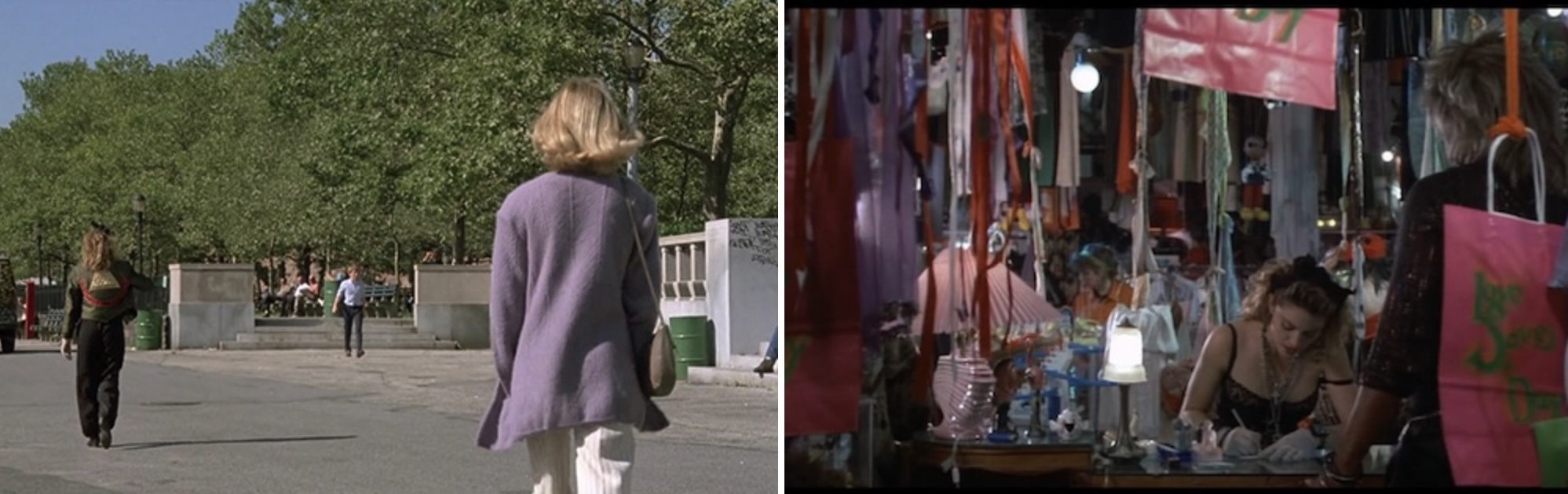
Roberta posts an ad in the paper, arranging to meet Susan and return the key. Waiting in Battery Park, she is accosted by Nolan, who mistakes her for Susan because she is blonde and wearing Susan’s former jacket. At this point in the film, Meeker is dead. Nolan wants to retrieve his earrings and believes Susan was involved, seeking revenge. Nolan knocks Roberta over and she hits her head. She wakes up with no memory but is rescued by Jim’s best friend Dez (Aidan Quinn), a projectionist, who also mistakes her for Susan. The plot’s amnesia device ushers in a self-dissolution where Roberta effectively lives as Susan, merging with the everyday motion of the streets. Temporarily liberated from heterosexual domesticity, she is finally able to live the life of urban freedom she associates with Susan. Dez takes Roberta to the Port Authority locker, where she finds Susan’s suitcase and the other earring. He then offers for Roberta to spend the night with him in his loft. However, they arrive to find Dez’s girlfriend moving out with all the furniture. With no couch to sleep on, Roberta sleeps with Dez on the floor. They begin to share romantic feelings, but as Roberta starts to regain her memory, she feels conflicted and leaves. After being jailed for stiffing a cab driver, Susan sets out to find Roberta, who has also been arrested—mistaken for a sex worker. Dez, now aware that Roberta is not Susan, bails her out and brings her back to his loft, a space emblematic of SoHo’s bohemian artist culture (Andersson, 2019: 336). With its high ceilings, large windows, and exposed brick, the space reflects the “artist loft” aesthetic central to the romanticization of marginal spaces during second-wave gentrification. When Roberta returns to the loft, she takes on a gentrifier’s mindset when she matter-of-factly says, “You could do a lot with this space. There’s a lot of light” (ibid). The critical issue here is that Roberta’s urban agency relies on a reimagined cityscape and the displacement of those who preceded her. While she embraces her fantasy of anonymous urban freedom, Dez, an artist dependent on affordable rent, faces growing precarity: his (ex-)girlfriend has taken all his furniture in pursuit of the next real estate deal, and with no one to share the rising rent, his ability to remain in the loft is uncertain.

In one of the film’s most emblematic moments, Susan lounges on a discarded couch outside the Magic Club on the Lower East Side. This image dramatizes a fleeting becoming-imperceptible: she blends into the urban detritus, occupying a liminal space where visibility slips into ambiguity. While the scene stylizes the neighborhood’s reputed danger as eccentric charm, it also reflects Susan’s confident navigation of a space marked as socially peripheral (Wilson, 1995: 154). In reality, however, the discarded couch, though rendered quirky by the film’s aesthetic, would signify eviction and dispossession (ibid). Andersson notes how such portrayals obscure the material realities of marginalized urbanites—racial minorities, sex workers, the unhoused—who are relegated to the background of the film’s visual field (2019: 338). Despite its queer resonances—two women pursuing self-reinvention beyond heteronormativity—the film conspicuously omits queer presence, especially the impact of the HIV/AIDS crisis (ibid), which profoundly shaped the city’s sociospatial dynamics as apartments emptied by deceased gay and bisexual men became real estate opportunities (Schulman, 2012). What appears as freedom in the frame thus depends on the erasure of those whose disappearances are not chosen but enforced.
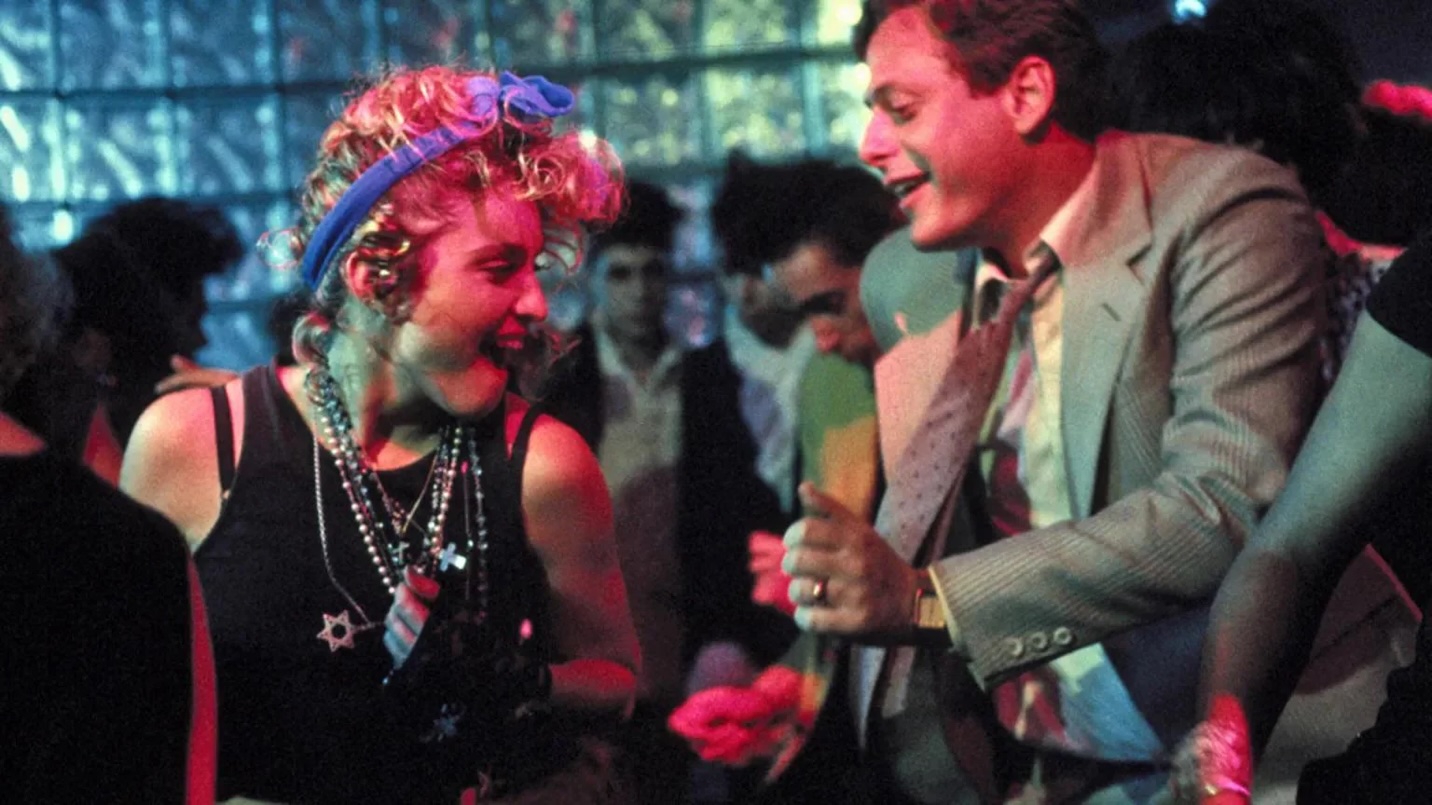
This tension between agency, displacement, and urban transformation also unfolds in the film’s engagement with nightlife as a site of reimagined belonging. The nightclub scene, set in the iconic Danceteria, opens up space for a queer-feminist reading, encapsulating a politics of collectivity and transformation grounded in bodily presence and ephemeral affect, although one that cannot escape the broader forces of redevelopment and exclusion that define the shifting urban landscape. In this scene, Susan dances to Madonna’s own “Into the Groove,” surrounded by a throng of bodies in motion. The camera does not frame her for male consumption but rather situates her within a pulsating, egalitarian field of movement. The choreography of the scene privileges no single viewpoint or stable subject (Ettinger, 1995). Like the music and the crowd, Susan is caught in constant flux. In this way, the nightclub becomes a heterotopia insofar as it inverts, disrupts, and mirrors the dominant social order while remaining immanent to it. Importantly, this heterotopic function is not merely aesthetic but political. The club scene enacts a minoritarian becoming—a sensory, durational experience that resists teleology and hierarchy. With its sweat-slicked bodies, rhythmic lighting, and immersive soundscape, the mise-en-scène foregrounds the nightclub as an active agent in the characters’ transformations: a “stochastic serialization of actions” that is less an “inversion of hierarchical power” than a “felt discontinuity of succession” (Panagia, 2013: 2). Like Madonna’s “Burning Up,” Susan is not defined here by narrative function but by intensity and imperceptibility. She becomes a node of relationality and possibility, untethered from the obligations of identity or plot, “as if the film were sending ripples of affect and thought across a diversity of its moments” (del Río, 2008: 160). Susan’s dancing is also a form of “counter-conduct”—a mode of resisting disciplinary power and “governmentality” by inhabiting alternative rhythms, affects, and relations that defy coercive normalization (Foucault, 2007: 197–198). And yet, the club’s political potential is not unlimited. As geographer Laam Hae notes, New York nightlife in the 1980s was increasingly regulated under the guise of public safety and moral order (2012: 68). Cabaret laws, zoning restrictions, and enhanced policing initiatives that targeted venues like Danceteria were part of a broader strategy of urban “clean-up” that accompanied gentrification (ibid). In this sense, the nightclub scene is both a utopic rupture and a nostalgic gesture. It captures the fleeting autonomy and radical potential of nightlife while anticipating its foreclosure under neoliberal regimes of control. This ambivalence is central to the film’s larger argument about space, gender, and resistance. The nightclub scene visualizes a suspension of disciplinary norms—a moment where queer temporality and feminist becoming flourish, albeit temporarily. It is a site where bodies can disarticulate from social scripts and enact new configurations. Yet, the very conditions that make such disarticulation possible—ambiguity, mobility, excess—are also those that render these spaces vulnerable to regulation and disappearance. The club, like Susan, is impermanent, ephemeral, and deeply enmeshed in the shifting politics of urban visibility. Thus, the scene does not merely provide an atmospheric interlude but crystallizes the film’s central preoccupations. It affirms that queer-feminist resistance is not always dramatic or permanent but sometimes exists in momentary affective convergences. The politics of the nightclub inheres in its capacity to host such convergences, gesturing toward alternate forms of becoming in the city.
In the film’s final scenes, Roberta—once again caught in mistaken identity—has taken Susan’s job at the Magic Club. Nolan attacks her backstage, still pursuing the earrings. Susan intervenes, and Nolan is knocked unconscious. The two women finally meet and are celebrated in the local paper for returning the earrings to their rightful owner. As Stacey notes, Roberta’s “desire to become more like her ideal” receives “temporary narrative fulfillment” (1987: 61). Yet, this desire “cannot be collapsed into simple identification, since difference and otherness are continuously played upon” (ibid). In my view, the ending inscribes Susan and Roberta into urban mythology and iconography. In this fictionalized New York, they become “it girls,” reinforcing the city’s image as a space of eccentric charm rather than class division. The gentrification narrative continues—rhizomatically and without resolution. More importantly, the ending reveals the limitations of anonymity and imperceptibility as feminist strategies. Though Susan and Roberta can blend into the cityscape, evading heteropatriarchal mechanisms, they remain entangled with mobsters, the state, and the police. They exist in agonistic tension with the state’s dispositif—a “relationship which is at the same time reciprocal incitation and struggle[, or a] permanent provocation” (Foucault, 1982: 790). Roberta in particular learns that while suburban disciplinary norms are oppressive, the city imposes its own forms of governance. In the absence of robust feminist and labor movements, anonymity and imperceptibility remain momentary insurrections. As Garber states, anonymity “has no room for politics if it is understood strictly as being unnamed, unidentified, or unrecognized” (2000: 33).
Conclusion
Desperately Seeking Susan dramatizes the fleeting feminist potential of urban space, staging anonymity and becoming-imperceptible as tactics of resistance within an overdetermined landscape. It resolves neither patriarchy nor gentrification but inhabits their contradictions. Like the city it portrays, the film offers no stable ground—only the chance to move, merge, and briefly disappear. These tensions feel even more urgent today. As cities gentrify under neoliberal regimes, public space is increasingly privatized, and surveillance technologies saturate everyday life. Deleuze’s (1992) concept of “control societies”—where disciplinary enclosures give way to continuous monitoring and data capture—helps name a world in which subjects are rendered legible and docile through networked visibility. In this context, the film’s fleeting acts of becoming-imperceptible take on renewed significance. They reveal both the allure and the limits of anonymity as feminist spatial agency: a refusal to be captured, fixed, or commodified.
Revisiting these ephemeral becomings in a past cinematic New York offers insight into enduring struggles over who has the right to disappear, to reconfigure space, and to slip outside the logics of recognition and control. In an algorithmic age of tracking and datafication, Desperately Seeking Susan evokes a time when the city could offer refuge from hegemonic modes of surveillance. But it also gestures toward a persistent fantasy: that somewhere within the cracks of the urban fabric, there are “lines of flight [or escape]” (Deleuze and Guattari, 2004: 11). The film does not romanticize disappearance but frames it as a contingent and embodied strategy—a queer-feminist politics of mobility that resists legibility on dominant terms. In this way, the film speaks not only to a specific historical moment but also to an ongoing struggle to inhabit space differently. It invites us to imagine what kinds of urban life become possible when visibility is not the price of participation, and when resistance resides in transience, opacity, and movement.
Acknowledgements
The author thanks Emilio Dabed, Jessica Eisen, Catherine Kellogg, Amy Parks, Chloë Taylor, and Rebecca Wissink for their insightful comments on earlier drafts of this article, as well as on the versions presented at the 2025 graduate conference hosted by the Department of Communication, Media and Film Studies at the University of Calgary and at the 2025 annual meeting of the Film and Media Studies Association of Canada. Gratitude is also extended to the FMSAC panel organizers and attendees, especially Grace An, Jeri English, Melissa Noventa, and Lubna Taha. The author further discloses that ChatGPT was used to assist with sentence-level and structural editing to improve clarity, coherence, and concision. All intellectual contributions—including ideas, arguments, interpretations, and theoretical framing—are solely the author’s. ChatGPT was not used to conduct research or draw on external sources. To preserve academic integrity and protect intellectual property, memory functions were disabled, and additional measures were taken to ensure that the manuscript was not stored or used for model training. All output was independently verified to confirm that no plagiarism was introduced.
Notes
- Stacey’s point anticipates Judith Butler’s later argument about gender as performatively constructed within culture in her seminal book, Gender Trouble: Feminism and the Subversion of Identity, originally published in 1990 (2007).
- Becoming refers to “a multiple and constant process of transformation” (Braidotti, 1993: 44). Attuned to the connectivity, fluidity, and transformation with and within the surrounding environment, becoming-imperceptible occurs when identity, individuality, and visibility are rendered diffuse and ungraspable by dominant power structures. It is the “immanent end of becoming, its cosmic formula” (Deleuze and Guattari, 2004: 308).
- The male gaze refers to the ways that mainstream media often depict women from a heterosexual male perspective, reducing them to spectacular objects of desire rather than as narrative agents. For critiques of this framework, see de Lauretis (1987) and Edelman (1999).
- The flâneur refers to a detached, observant urban wanderer—someone who strolls through the city, particularly modern cities like Paris, as both spectator and interpreter of everyday life. Theorized by Benjamin as a male figure, the flâneur experiences the city through observation rather than participation, absorbing its rhythms, people, and spaces without ever being fully ensconced (Chisholm, 2004: 46–49).
- See also Buchanan and Lambert (2005).
- Shannon Bell defines postmodernism as a socio-aesthetic milieu characterized by “fragmentation, indeterminacy, parody, and pastiche” (1994: 4). It reflects diffused power structures, the collapse of grand narratives, mediated realities, and the discursivity of identity and subjectivity (ibid). The “queen of reinvention,” Madonna embodies the social construction of celebrity and the fluidity of gender, aligning with postmodernism’s embrace of pastiche, transformation, and cultural recycling. Jean Baudrillard would describe her as a “simulacrum”—a “real without origin” (1994: 1). E. Ann Kaplan locates Madonna’s postmodern feminism in her defiance of binaries such as “male/female, high art/pop art, film/TV, fiction/reality, private/public” (2016: 126), while Cathy Schwichtenberg finds it in music videos like “Express Yourself” (1989) and “Justify My Love” (1990), which present “a flux of identities” and a “stylistic challenge to an ontological notion of sexuality” (1992: 22). Madonna’s contradictions and irony are also distinctly postmodern. In “Material Girl” (1985), she campily portrays a girlish gold-digger, referencing Marilyn Monroe’s Lorelei Lee in Gentlemen Prefer Blondes (1953). Elegantly descending an Old Hollywood soundstage in mink, she teases suitors and flirts with the camera, simultaneously invoking 1950s glamour and the “greed is good” ethos of 1980s Reaganite capitalism. Yet, she also ironizes Lee’s decorous femininity through a drag performance that, in Butlerian terms, is “not unproblematically subversive” but instead reflects “the mundane impersonations by which heterosexually ideal genders are performed and naturalized” (2011: 85). For a discussion of Madonna as a postmodern figure, see Cvetkovich (1993). On her postmodern camp aesthetic within queer cultural production—particularly in “Vogue” (1990)—see Robertson (1996: 115–138). For critiques of Madonna as a postmodern feminist, see Bordo (1993) and Freccero (1992). Regarding Madonna’s engagement with queer imagery and cultural practices, see Califia (1993) and Ross (2017: 169–173); for a critique centered on queer-of-color frameworks, see hooks (1995).
- For a brilliant analysis of queer subjectivity and spatiality in the wake of the time-image, see Pidduck (2004).
- While often overtly sexual (Delany, 1999), queer spaces also make room for nonsexual forms of desire and identification. The queerness of space—rather than any fixed, ontologically “queer” space—can emerge through the city’s rhythmic flux rather than within discrete, bounded locations, as illustrated in Desperately Seeking Susan, where queerness and spatiality are immanent to one another. For a Deleuzian account of queer becoming beyond sex and sexuality, see Kedem (2024). For an academic analysis of queer spatiality that forgoes the explicitly erotic, see Nunoda (2020).
- Andersson effectively draws on Lee Edelman’s critique of “reproductive futurity,” in which heteronormative society centers the child as a disciplinary figure that defines political legitimacy and excludes queerness (2004: 3). Insofar as Susan and Roberta defy the sociocultural imperative to reproduce and to settle for a life of quiet domesticity, they enact a queer temporality outside of heteronormative futurity.
- Davis proposes the “desiring-image” as a supplement to Deleuze’s movement- and time-image regimes: “the desiring-image [is] both a sequel to Deleuze’s cinematic conceptions of movement and time and [a] constitutive dimension of all cinematic images—just as the time-image lingered as untapped potential within more regulated cinemas of movement. Queer insofar as they take open-ended variation as their guiding premise, desiring-images work against normative models of sexuality and their social, political, and epistemic buttresses. They simultaneously mirror time-images in resisting uniformity and rational organization; they dovetail with persistent structures of movement- and time-based cinema; and they resist the masculinist and heterosexist ideologies so prevalent in both” (2013: 8).
- In a sharp rebuke of 1970s feminist and psychoanalytic film theory, Deleuzian film theorist Elena del Río emphasizes what the body can do beyond its cultural positioning—“an ontology of becoming rather than being.” Instead of positioning the female body as a site of oppressive heterosexual desire, del Río highlights its agency through kinetic energy and affect, which she defines, following Deleuze and Guattari, as “the body’s capacities to affect and be affected by other bodies, thereby implying an augmentation or diminution in the body’s capacity to act” (2008: 7–10). She coins the term “affective-performative cinema” to describe films in which affect and corporeality subvert narrative and ideological paradigms, foregrounding sensation, movement, and transformation over fixed meaning (ibid: 1-25).
- In both “Burning Up” and Desperately Seeking Susan, alternative intimacies, reversals of power, and disidentifications with heteronormative femininity frame subcultural space and performance as queer world-making—worlds that “necessarily include more people than can be identified, [and] more spaces than can be mapped beyond a few reference points” (Berlant and Warner, 1998: 558).
- Importantly, Madonna appears as both desiring and desiring-to-be-seen, yet she resists legibility and containment within the logic of the male gaze. Further, her emerging sex-positivity is evident in her assertive control over her sexuality and her playful return of the gaze—an embodied contradiction to the lyrical plea, “Do you want to see me down on my knees?” For Deleuzian feminist film theory that displaces the visual mastery underpinning the male gaze—favoring affect, temporality, and embodied spectatorship—see Boljkovac (2013); for more on sex-positive feminism, see Duggan and Hunter (1995). For libertarian, sex-positive readings of Madonna herself, see Paglia (1990; 1992: 3-13).
- Drawing on Foucault’s later work, feminist philosopher Chloë Taylor argues that the modern nuclear family remains structured by “sovereign power”—grounded in blood ties and backward-looking rituals like marriage—while simultaneously serving as a conduit for disciplinary and “biopolitical” forces (2012: 202). In this framework, the suburban home is not merely a private refuge but a key site where subjects are normalized through routines, surveillance, and gendered expectations. Roberta’s role as wife and homemaker can thus be understood as doubly constrained: by the sovereign authority of the marital institution and by the disciplinary imperatives of domestic labor, femininity, and emotional self-regulation. Her flight to Manhattan is not just a rebellion against boredom or conformity, but a refusal of the historically layered hybrid of sovereign and disciplinary power that governs her suburban identity.
- Here, becoming-imperceptible is also intertextual. We are not just seeing Susan, but Madonna, whose star image, as Richard Dyer (1979) would argue, is constructed across music videos, film roles, publicity, and cultural discourse. Her presence complicates the scene: she appears both as character and as celebrity, a figure who might plausibly be found lounging on a derelict New York street in real life. This slippage between persona and performance aligns with her queerly ethereal star script, blurring visibility and disappearance in ways that deepen the moment’s affective charge.
- However, this peripherality might be understood, via Deleuze’s concept of the “out-of-field,” as a site of latent presence rather than mere absence—what is “neither seen nor understood, but nevertheless perfectly present.” The film’s failure to integrate marginal figures into its narrative foreground may not erase them so much as gesture toward a structural exclusion that silently undergirds Susan’s world (Deleuze, 1986: 16).
- Governmentality refers to the evolving techniques and rationalities through which power governs populations by shaping behavior, rather than relying solely on law or force (Foucault, 2007: 197–198). The nightclub scene can be said to resist governmentality insofar as social norms associated with 1980s capitalist individualism are temporarily resisted through an overarching communitarian spirit grounded in togetherness and escape from the relative outside.
- With “queer temporality,” I refer to the multitudinous ways that queer and other non-normative individuals and constituencies both experience and enact time outside of marriage, family, reproduction, extraction, and labor (Edelman, 2004; Freeman, 2010; Halberstam, 2005, 2011; Love, 2007).
- Crucially, the nightclub scene enacts a cinematic space of emergent potential where subjectivity flickers, pulses, and opens beyond narrative constraint (del Río, 2008; Thain, 2017; Torlasco, 2021).
- Deleuze and Guattari define a “line of flight” as a transformative rupture or escape from hegemonic, majoritarian forms of power—a line of “absolute deterritorialization” (2004: 226).
References
Andersson, J. (2019). “Gentrification by Genre: Desperately Seeking Susan and the 1980s Screwball.” In: Andersson, J. and Webb, L. (eds.), The City in American Cinema: Film and Postindustrial Culture. London: Bloomsbury, pp. 329-349.
Baudrillard, J. (1994 [1981]). Simulacra and Simulation (tran. S.F. Glaser). Ann Arbor: The University of Michigan Press.
Bego, M. (1992). Madonna: Blonde Ambition. New York: Three Rivers Press.
Bell, S. (1994). Reading, Writing, and Rewriting the Prostitute Body. Bloomington / Indianapolis: Indiana University Press.
Benjamin, W. (2023 [1973]). Charles Baudelaire: A Lyric Poet in the Era of High Capitalism (tran. H. Zohn). London: Verso.
Berlant, L. (2011). Cruel Optimism. Durham / London: Duke University Press.
Berlant, L. and Warner, M. (1998). “Sex in Public.” Critical Inquiry, 24(2), 547–566.
Boljkovac, N. (2013). Untimely Affects: Gilles Deleuze and an Ethics of Cinema. Edinburgh: Edinburgh University Press.
Bordo, S. (1993). “‘Material Girl’: The Effacements of Postmodern Culture.” In: Schwichtenberg, C. (ed.), The Madonna Connection: Representational Politics, Subcultural Identities, and Cultural Theory. New York: Routledge, pp. 265–290.
Braidotti, R. (1993). “Discontinuous Becomings: Deleuze on the Becoming-Woman of Philosophy.” Journal of the British Society for Phenomenology, 24(1), 44–55.
Buchanan, I. and Lambert, G. (eds.) (2005). Deleuze and Space. Edinburgh: Edinburgh University Press.
Butler, J. (2007 [1990]). Gender Trouble: Feminism and the Subversion of Identity. London / New York: Routledge.
Butler, J. (2011 [1993]). Bodies That Matter: On the Discursive Limits of “Sex”. London / New York: Routledge.
Califia, P. (1993) “Sex and Madonna, or, What Did You Expect from a Girl Who Doesn’t Put Out on the First Five Dates?” In: Frank, L. and Smith, P. (eds.), Madonnarama: Essays on Sex and Popular Culture. San Francisco: Cleis Press, pp. 169–184.
Chisholm, D. (2004). Queer Constellations: Subcultural Space in the Wake of the City. Minneapolis: University of Minnesota Press.
Clarke, D.B. and Doel, M.A. (2016). “Cinematicity: City and Cinema after Deleuze.” Journal of Urban Cultural Studies, 3(1), 3–11.
Cvetkovich, A. (1993). “The Powers of Seeing and Being Seen: Truth or Dare and Paris Is Burning.” In: Collins, J., Collins, A.P. and Radner, H. (eds.), Film Theory Goes to the Movies: Cultural Analysis of Contemporary Film. London / New York: Routledge, pp. 155–169.
Davis, N. (2013). The Desiring-Image: Gilles Deleuze and Contemporary Queer Cinema. Oxford: Oxford University Press.
de Lauretis, T. (1987). Technologies of Gender: Essays on Theory, Film, and Fiction. Bloomington / Indianapolis: Indiana University Press.
del Río, E. (2008). Deleuze and the Cinemas of Performance: Powers of Affection. Edinburgh: Edinburgh University Press.
Delany, S.R. (1999). Times Square Red, Times Square Blue. New York: NYU Press.
Deleuze, G. (1986 [1983]). Cinema 1: The Movement-Image (tran. H. Tomlinson and B. Habberjam). Minneapolis: University of Minnesota Press.
Deleuze, G. (1992). “Postscript on the Societies of Control.” October, 59, 3–7.
Deleuze, G. (2006 [1993]). The Fold: Leibniz and the Baroque (tran. T. Conley). London / New York: Continuum.
Deleuze, G. and Guattari, F. (2004 [1980]). A Thousand Plateaus: Capitalism and Schizophrenia (tran. B. Massumi). London: Bloomsbury.
Duggan, L. and Hunter, N.D. (1995). Sex Wars: Sexual Dissent and Political Culture. London / New York: Routledge.
Dyer, R. (1979). Stars. London: British Film Institute.
Edelman, L. (1999). “Rear Window’s Glasshole.” In: Hanson, E. (ed.), Out Takes: Essays on Queer Theory and Film. Durham / London: Duke University Press, pp. 72–96.
Edelman, L. (2004). No Future: Queer Theory and the Death Drive. Durham / London: Duke University Press.
Ettinger, B.L. (1995). The Matrixial Gaze. Leeds, UK: Feminist Arts and Histories Network, Department of Fine Art, University of Leeds.
Foucault, M. (1982). “The Subject in Power.” Critical Inquiry, 8(4), 777–795.
Foucault, M. (1986). “Of Other Spaces” (tran. J. Miskowiec). diacritics, 16(1), 22–27.
Foucault, M. (1978 [1976]). The History of Sexuality, Volume I: An Introduction (tran. R. Hurley). New York: Pantheon Books.
Foucault, M. (2007). Security, Territory, Population: Lectures at the Collège de France, 1977–78 (ed. M. Senellart; tran. G. Burchell). New York: Palgrave Macmillan.
Freccero, C. (1992). “Our Lady of MTV: Madonna’s ‘Like a Prayer.’” boundary 2, 19(2), 163–183.
Freeman, E. (2010). Time Binds: Queer Temporalities, Queer Histories. Durham / London: Duke University Press.
Gao, J. (2013). “Deleuze’s Conception of Desire.” Deleuze Studies, 7(3), 406–420.
Garber, J.A. (2000). “‘Not Named or Identified’: Politics and the Search for Anonymity in the City.” In: Miranne, K.B. and Young, A.H. (eds.), Gendering the City: Women, Boundaries, and Visions of Urban Life. Lanham MD: Rowan & Littlefield, pp. 19–39.
Hae, L. (2012). The Gentrification of Nightlife and the Right to the City: Regulating Spaces of Social Dancing in New York. London / New York: Routledge.
Halberstam, J. (2005). In a Queer Time and Place: Transgender Bodies, Subcultural Lives. New York: NYU Press.
Halberstam, J. (2011). The Queer Art of Failure. Durham / London: Duke University Press.
hooks, b. (1995). “Madonna: Plantation Mistress or Soul Sister?” In: Dines, G. and Humez, J.M. (eds.), Gender, Race and Class in Media: A Text-Reader. Thousand Oaks CA: Sage Publications, pp. 28–32.
Jacobs, J. (1992 [1961]). The Death and Life of Great American Cities. New York: Vintage Books.
Kaplan, E.A. (2016 [1987]). Rocking Around the Clock: Music Television, Postmodernism, and Consumer Culture. London / New York: Routledge.
Kedem, N. (2024). A Deleuzian Critique of Queer Thought: Overcoming Sexuality. Edinburgh: Edinburgh University Press.
Lawrence, T. (2016). Life and Death on the New York Dance Floor, 1980-1983. Durham / London: Duke University Press.
Lees, L., Slater, T. and Wyly, E. (2008). Gentrification. London / New York: Routledge.
Lefebvre, H. (1991 [1974]). The Production of Space (tran. D. Nicholson-Smith). Oxford: Blackwell.
Love, H. (2007). Feeling Backwards: Loss and the Politics of Queer History. Cambridge, Mass: Harvard University Press.
Mulvey, L. (1975). “Visual Pleasure and Narrative Cinema.” Screen, 16(3), 6–18.
Nunoda, E. (2020). “I Think We’re Alone Now: Dead Malls and the Queerly Unconsummated.” Feminist Media Histories, 6(4), 183–210.
Paglia, C. (1990). “Madonna—Finally, A Real Feminist.” The New York Times, 14 December. Available at: nytimes.com/1990/12/14/opinion/madonna-finally-a-real-feminist.html (accessed 30 June 2025).
Paglia, C. (1992). Sex, Art, and American Culture: Essays. New York: Vintage Books.
Panagia, D. (2013). “Why Film Matters to Political Theory.” Contemporary Political Theory, 12(1), 2–25.
Pidduck, J. (2004). “New Queer Cinema and Experimental Video.” In: Aaron, M. (ed.), New Queer Cinema: A Critical Reader. New Brunswick NJ: Rutgers University Press, pp. 80–98.
Ricco, J.P. (2002). The Logic of the Lure. Chicago: University of Chicago Press.
Robertson, P. (1996). Guilty Pleasures: Feminist Camp from Mae West to Madonna. Durham / London: Duke University Press.
Ross, B.L. (2017 [1997]). “‘It’s Merely Designed for Sexual Arousal’: Interrogating the Indefensibility of Lesbian Smut.” In: Cossman, B., Bell, S., Gotell, L. and Ross, B.L., Bad Attitude/s on Trial: Pornography, Feminism, and the “Butler” Decision. Toronto: University of Toronto Press, pp. 152–198.
Schulman, S. (2012). The Gentrification of the Mind: Witness to a Lost Imagination. Oakland: University of California Press.
Schwichtenberg, C. (1992). “Madonna’s Postmodern Feminism: Bringing the Margins to the Center.” Southern Journal of Communication, 57(2), 120–131.
Shaviro, S. (2010). Post‑Cinematic Affect. Winchester: Zer0 Books.
Solomon, J. (2013). “Music Scene Gentrification in the Lower East Side and Williamsburg.” Thesis. Vassar College. Available at: core.ac.uk/download/pdf/10673333.pdf (accessed 30 June 2025).
Soja, E.W. (1996). Thirdspace: Journeys to Los Angeles and Other Real-and-Imagined Places. Oxford: Wiley.
Stacey, J. (1987). “Desperately Seeking Difference.” Screen, 28(1), 48–61.
Taylor, C. (2012). “Foucault and Familial Power.” Hypatia: A Journal of Feminist Philosophy, 27(1), 201–218.
Thain, A. (2017). Bodies In Suspense: Time and Affect in Cinema. Minneapolis: University of Minnesota Press.
Torlasco, D. (2021). The Rhythm of Images: Cinema Beyond Measure. Minneapolis: University of Minnesota Press.
Wilson, E. (1992). “The Invisible Flâneur.” New Left Review, 191, 90–110.
Wilson, E. (1995). “The Rhetoric of Urban Space.” New Left Review, 209, 146–160.
Žukauskaitė, A. (2017). “Deleuze, Simondon, and Beckett: From Being to Becoming.” In: de Assis, P. and Giudici, P. (eds.), The Dark Precursor: Deleuze and Artistic Research, Volume I: Sound and Writing. Leuven, Belgium: Leuven University Press, pp. 272–278.
Zukin, S. (1989). Loft Living: Culture and Capital in Urban Change. New Brunswick NJ: Rutgers University Press.
Cite this Essay
Chittick, Kyler. “Anonymity and Becoming-Imperceptible on the Lower East Side: Gender and Gentrification in Desperately Seeking Susan.” Rhizomes: Cultural Studies in Emerging Knowledge, no. 41, 2026, doi:10.20415/rhiz/041.e02