Rhizomes: Cultural Studies in Emerging Knowledge: Issue 41 (2026)
The Trauma of Existing: A Review of Robert Seidel’s Hysteresis, Followed by an Interview with the Artist
John Hawkins
University of New England
Abstract: This hybrid work combines art criticism and artist interview to examine Robert Seidel’s experimental film Hysteresis (2021) as a meditation on consciousness at the threshold of human-machine convergence. Drawing on Maurizio Ferraris’s concept of hysteresis—the persistence of effects beyond their causes—the paper argues that Seidel’s five-minute film offers a rare aesthetic glimpse into potential AI consciousness through its fusion of human performer Tsuki’s embodied movement with machine-generated visual transformations created from art historical datasets. The review section analyzes how the film’s constantly shifting abstract imagery presents what may be understood as machine dreaming or artificial spontaneity, while the subsequent interview with Seidel reveals the collaborative and methodical processes behind this apparent spontaneity, exploring broader questions about artistic agency, queer embodiment, and the role of art in navigating technological singularity. Through close attention to the film’s technique and the artist’s reflections on his practice, this work contributes to emerging discussions about empathy between humans and machines, the aesthetics of artificial intelligence, and art’s capacity to envision future modes of consciousness, ultimately suggesting that collaborative artistic practices like Seidel’s offer a model for aesthetic synthesis that honors both human creativity and machine possibility.
The Review
“One must still have chaos in oneself to be able to give birth to a dancing star.”
— Friedrich Nietzsche, Thus Spoke Zarathustra
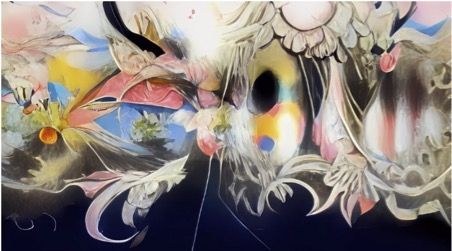
Hysteresis, the award-winning five-minute film by Berlin-based artist Robert Seidel, is an exemplary experiment in the symbiosis between human consciousness and AI machine-rendered play with form and texture. The film has just returned home after a two-year tour of screenings on the indie film circuit that included Berlin, Taipei, Taichung, Ann Arbor, Rio de Janeiro, and Glasgow. In the latter venue, Hysteresis was part of a festival: Rise of the Empathy Machines: Do You See What (A)I See? And this is as good an entry as any into what Seidel’s current project is all about.
The festival featured human intersections and interactions with machines, of which AI is a sub-product. The ALT/KINO festival website tells us:
How does artificial intelligence see the world? And how does it interpret and process what it sees? … As the discourse becomes ever more infatuated with the output of machine learning, this selection of films seeks to understand how what it yields is a reaction to what data has been fed into it. Ranging from the reflections of a machine poet about human-shot footage to the existential musings of a self-driving car, this programme wonders what is going on in the mind of an AI as it observes, processes, interacts with, and, ultimately, remakes the world.
Hysteresis was the feature short of this festival.
The notion that one can be an empath with machines, or, as Psychology Today has referred to them, “synesthetes” with “a rare form of mirror-touch synesthesia—profound empathy extending to machines” (Seaberg, 2015), is shocking and profound in its implications. I am especially interested in this phenomenon, as I have been doing research on technological singularity for a doctoral dissertation, and recently published a piece in NanoEthics that examines consciousness as it may apply to machines through the lens of paradigm shifts (Hawkins, 2025). In that work, I argue that understanding consciousness—both human and potentially artificial—requires recognizing our paradigm-bound assumptions. For these engagements to work, brain-computer interfaces must translate brain signals to digital commands, implying that thoughts can be digitized. This possibility has some BCI company executives, such as Elon Musk, enthusiastic about a future when humans will possess machine-mediated telepathy. What one wonders is whether such “mediation” amounts to machine consciousness.
But what is hysteresis? In his book Hysteresis (2023), Maurizio Ferraris argues that hysteresis is a fundamental feature of human experience. He writes, “hysteresis is the ability of effects to survive even when their causes have ceased to exist” (p. 15). This means that the past is never truly gone and can continue to shape the present in ways we may not even be aware of. For artists and cultural producers, this understanding of hysteresis can be a powerful tool. It can help us see the connections between past and present and use them to create new and innovative work. It can also help us to challenge the status quo and to imagine new possibilities for the future.
Ferraris extends this concept into a comprehensive metaphysical framework. He argues that hysteresis operates as “the transcategorial (the transcendental in the classical sense, the metaphysical structure) which, being transversal, questions the traditional distinctions between physis and nomos, physis and techne, and in general between natural and artificial” (Ferraris, 2023, p. 92). This radical claim positions hysteresis not merely as a feature of experience but as the fundamental organizing principle of reality itself—one that bridges the domains of nature, technology, and culture. Most critically, Ferraris insists that “recording, the ability to keep track, is the origin of emergence” (p. 87), suggesting that the capacity to inscribe and preserve traces is prior to both ontology and epistemology.
In Hysteresis, Seidel uses digital technology to explore the ways in which past events can be reactivated in the present through precisely this mechanism of recording. On Seidel’s website, the artist tells us that he is “[u]nveiling a frenetic, delicate and flamboyant visual language that speaks to the hysteria and hysteresis in this historical moment” and that he “wants to open a discourse about these unique modes of AI creation – with implications beyond the film and other media, to that singularity, where history collapses into a single point in the present.” Have we reached the event horizon at which civilization and its experiment in light and bio have begun to be pulled into the hole we dug for ourselves? This would account for the hysteria of eschatological vibes in the air.
The short film is intense and frantic, and full of the light of reason. Chaos and incoherence, too. It’s a melting pot for the interpenetrability of all being, or, as David Finkelstein, author of Stem Cells of the Mind, is quoted at the site saying of the film, “…such a web fascinates us because it resembles so closely the way that the mind works all the time, whether we’re aware of it or not, reflecting the dense interconnections of all existence.” And I agree.
For artists and cultural producers, this understanding of hysteresis can be a powerful tool.
The viewer is warned of graphic imagery and flashes that could affect epileptic viewers. I had a strong visceral response; felt pulled into a process I didn’t understand but was fascinated by. And though it has, at first, the confronting energy of a hot spanking Yoko Ono primal scream, Hysteresis happens in a space where no one can hear you scream. Seidel writes, “No origin, no responsibility, no clear bias – just a primordial soup that can be transformed into any form without questioning knowledge systems and hierarchies.” Absolute Possibility. It brings, for a moment or two, vertigo.
A narrative thread has queer performer Tsuki dancing ritually and gesturally, embodying aspects of theatre, including Ballet, Butoh and Berlin club culture. This is a strange combination to me at first, as when I consider Berlin club culture, for instance, I recall watching the splendid TV series Babylon Berlin, with its kinky nightclub doings darkly juxtaposed with the growing tension in Germany between Communists and the nascent fascists of the National Socialist movement.
Seidel writes of Tsuki, “In a fusion process, her image is recorded, fed back through Seidel's devices and then projected onto her body.” It’s fusion, and it’s fugal. This process demonstrates precisely what Ferraris means by hysteresis as emergence through recording: Tsuki’s movement (cause) is captured, iterated, and altered, generating visual effects that take on autonomous existence even as their origin remains visible. One question I had was whether this re-centering unfolding is the exclusive product of queer thinking or an opportunity to come to terms with the next paradigm shift ahead. Seidel writes, “The resulting Muybridgean silhouettes, baroque textures and bursting painterly structures fluctuate between the second and third dimensions, unfolding free-floating gestures that unhinge the laws of nature.” The word “unhinge” is rather strong.
Tsuki, Dancer of the New Ontology
Tsuki’s persona originated in the outer suburbs of Melbourne, Australia, on a Full Moon night in September 2017. Since that time, Tsuki has moved to Berlin, where she develops her performance and teaching practices encompassing Ballet, Butoh, Yoga, Moonology, Queerness, Articles & Poetry. Her work represents what might be called a non-binary philosophy of ballet—a decommissioning of traditional binary values in classical form.
Throughout 2021 and continuing into 2022, Tsuki facilitated Full Moon Rituals at studios, community centers, and parks across Berlin, collaborating with emerging DJs and sound artists from the local scene. These lunar-cycle-based community dance projects demonstrate Tsuki’s commitment to reimagining embodied practice outside conventional theatrical spaces.
In Hysteresis, her continuous movement and bodily interpretation of space become the raw material for Seidel’s AI transformations. What we witness is not simply a dancer performing for a camera, but a black swan ballet enactment with decommissioned binary values—movement that generates new aesthetic possibilities precisely because it refuses to remain within established categories.
Hysteresis seems to describe the way a machine might have lucid dreams. It’s an alien language, but to the sensitive viewer, it presents an internal logic that is not necessarily exclusive—and is rather provocative in the same way that the aliens are in the sci-fi film, Arrival, where a linguist is able to empathize with the internal structures of meaning proffered up by the creatures. Beyond the linguistic angle, I’m reminded of my readings in phenomenology so many years ago—in particular, the French philosopher Merleau-Ponty.
Hysteresis happens in a space where no one can hear you scream.
In his seminal work, The Primacy of Perception, Merleau-Ponty describes an oft-neglected aspect of seeing that is not common to most people but there as a default for the artist. He writes, “Since things and my body are made of the same stuff, vision must somehow come about in them; or yet again, their manifest visibility must be repeated in the body by a second visibility” (Merleau-Ponty, 1964/1968, p. 121). I submit that it is this second visibility that Seidel invites the viewer to participate in. The electromagnetic consciousness framework I have been developing suggests that if consciousness emerges from electromagnetic field dynamics, then Seidel’s work may provide a visual analogue of this process (Hawkins, manuscript under review). Tsuki’s embodied first visibility—her dancing body generating bioelectric activity—becomes transformed through technological mediation into a second visibility: the AI-rendered forms that constitute the film’s aesthetic experience.
This concept resonates with N. Katherine Hayles’ argument in Unthought that while technical systems and biological life-forms may perform structurally similar cognitive tasks, “those processes take place in very different material and physical contexts” (Hayles, 2017, p. 25). Hayles insists that we must distinguish between human consciousness and what she calls “nonconscious cognitions” in technical systems—not because one is superior, but because the material substrate fundamentally shapes the nature of cognitive processing. Yet Seidel’s work suggests an aesthetic space where these different cognitions might meet and interact. The film enacts what Hayles describes as the “exteriorization of cognitive abilities” (p. 117)—capacities once confined to biological organisms now instantiated in technological systems, creating new hybrid forms of meaning-making.
Donna Haraway’s Cyborg Manifesto provides another crucial lens for understanding Tsuki’s role in Hysteresis. Haraway argues that “late twentieth-century machines have made thoroughly ambiguous the difference between natural and artificial, mind and body, self-developing and externally designed” (Haraway, 1991, p. 152). More specifically, she notes that female embodiment has traditionally “seemed to be given, organic, necessary,” but the cyborg figure challenges these assumptions: “Cyborgs might consider more seriously the partial, fluid, sometimes aspect of sex and sexual embodiment. Gender might not be global identity after all” (p. 180). Tsuki’s queer performance—recorded, fed back, projected, and transformed—embodies this cyborg dissolution of boundaries. Her body becomes what Haraway calls a “hybrid of machine and organism, a creature of social reality as well as a creature of fiction” (p. 149), demonstrating how the breakdown of nature/technology distinctions operates through actual embodied practice rather than mere theory.
The phenomenology of the painter offers further illumination. Merleau-Ponty, analyzing Paul Cézanne’s work, emphasizes that authentic creation arises from physical, “carnal existence”: “The painter ‘takes his body with him,’says Valéry. And indeed, we cannot see how a Mind could paint. It is by lending his body to the world that the artist changes the world into paintings” (Merleau-Ponty, 1964/1968, p. 162). Tsuki lends her body to Seidel’s technological apparatus, and through this lending—this recording, iteration, and projection—the world changes into Hysteresis. The film becomes what Merleau-Ponty calls an “intertwining of vision and movement,” where meaning emerges not from mind imposing form on matter but from the body’s spontaneous engagement with its medium.
It may well be the essential makeup of machine consciousness understood as the sum of all possibilities. This aligns with my argument that consciousness in the age of AI requires new paradigmatic frameworks (Hawkins, 2025). Following Thomas Kuhn’s insight that scientific understanding progresses through paradigm shifts rather than linear accumulation, and Werner Heisenberg’s demonstration that observation affects the observed, we might understand both human and artificial consciousness as fundamentally perspectival. Hysteresis doesn’t resolve these questions but makes them aesthetically urgent.
Hysteresis features an excellent soundtrack from Oval (Markus Popp), itself an aural fracturing and reordering that incorporates oriental motifs and jazz sprays and sound effects of glass breakage that suggest a fantasia wherein nothing matters or, at least, where there is no permanence. Seidel writes of the Oval music: “The soundtrack by Oval incessantly corrodes this dense web of associations, threatening to dissolve the remaining fragile points of reference.”
Interview: Robert Seidel and John Hawkins on Art, AI, and Consciousness
Hawkins: I’ve been wondering what consciousness might look like in the age of AI—as we evolve, as we merge, as we become more compatible with one another and with our creations. I’m not sure it’s a bad thing if we merge. But the big question remains: who’s in charge?
What often gets left out of these conversations is ethics and aesthetics.
Your work is the closest I’ve seen to representing that. A few years ago, I reviewed a book on lucid dreaming in short films. Even before the AI boom, I was fascinated by how filmmakers were representing subconscious and unconscious impulses. Some films felt like they depicted a kind of membrane between the viewer and the otherworldly—between the conscious and unconscious. Your work brings that sensation more vividly to life. Watching Hysteresis, I felt like I was almost inside the brain of an AI.
Hawkins: It felt like a depiction of a sleeping consciousness—maybe a lucid dream a computer is having. I was fascinated by your technique and your approach.
Seidel: There’s something I wanted to bring up. In your article, you mentioned that the story of Tsuki seemed like a token element. But without her, the film wouldn’t exist. She’s integral.
Hawkins: That part of the film came to me secondarily, after the abstract visuals. But you’re right, I should have paid more attention to her presence.
Seidel: The film was created during the pandemic. I was stuck at home, unable to engage with audiences or share my work. Tsuki had been coming to my exhibitions for years. She was always quietly present—absorbing, not interrogating. After the first lockdown, we agreed to meet and start experimenting. I needed to reconnect with creativity.
Her continuous movement, her bodily interpretation of space, and the way I projected onto her—visually and metaphorically—opened my eyes again. Usually, I don’t include people in my films. But in this case, Tsuki helped me regain confidence and momentum. She moved in and out of the abstract visuals, becoming one with them. Her performance brought a human element that made the piece more accessible. Her queerness, too, reflects a kind of ongoing dialogue—with her body, identity, and the world around her—that mirrors the themes of the work.
Hawkins: It’s like a meeting of two alien forces that humanize each other. There’s a rhythm and a synthesis that makes intuitive sense. The imagery feels queer not just in terms of gender, but in its otherness—an alienness we fear, like we once feared queerness or even Alan Turing.
Hawkins: If I were to revisit my piece, I’d definitely give more space to Tsuki’s presence. I was overwhelmed by the visual impact of your work. Watching it again, I now see how vital her contribution was. Your film represents a possible aesthetic synthesis of human and machine. It’s art for art’s sake, not a moral argument—and that’s a good place to be.
Let’s move to the structured questions. I think that’ll help shape this transcript better.
Seidel: Absolutely. And if anything feels out of place later, we can shift or add as needed.
On Artistic Process and Abstraction
Hawkins: You’ve written about being influenced by Leibniz’s monad theory and starting with drawings. The resulting images feel like animated inkblots—but restless ones, constantly shifting. Is that a valid reading? How does this interweaving of memory, motion, and meaning work?
Seidel: That’s the core of my visual language. I’m inspired by multi-layered associations—drawings, fragments of sculpture, paintings—all in constant motion. Unlike the Rorschach inkblots, which are static and symmetrical, my images move. They shift rhythmically, creating new patterns of recognition. In this way, the work doesn’t present a single meaning but invites viewers to build their own narrative through what resonates with them. It’s a more contemporary approach, I think, since our lives and devices are in constant flux.
Hawkins: With your film Grau, I noticed it was split into three segments—white screen, black screen. Was there a narrative arc?
Seidel: Grau was my diploma piece. It was inspired by a near car accident, which sparked a reflection on memory and mortality. Each part represents a different emotional or sensory register: the chaos of the crash, the flood of memories, the final silence. I wanted something more personal than the typical life-arc montage. It’s speculative, yes—but rooted in real emotion.
On Spontaneity, AI, and Consciousness
Hawkins: One hallmark of human consciousness is spontaneity. Your films feel intuitively spontaneous—do they represent a kind of artificial spontaneity?
Seidel: I experiment constantly, but final compositions are carefully edited. I aim to retain that spark of spontaneity while creating something cohesive. If I can watch the film ten times and still feel curious, then I know it works. Grau, for instance, is nearly 20 years old and I still discover something in it. That emotional density is what I aim for.
Hawkins: As AI advances, there’s anxiety about merging with machines. Yet your work—especially Hysteresis—suggests a shared aesthetic space between us. Was that intentional?
Seidel: Yes, it was. I used datasets containing centuries of human art and tried to unfold all those styles at once. Hysteresis became a kind of art-historical time machine. It doesn’t generate anything radically new, but it allows you to navigate a latent space where all those styles intersect. It’s overwhelming in a good way—like experiencing an encyclopedia of art through movement.
On Technique, Editing, and Collaboration
Hawkins: How much footage did you shoot with Tsuki, and what was your editing process like?
Seidel: We had about five hours of material. I edited it down, applied AI transformations, and kept refining. I sought a balance of abstraction and intimacy—close-ups, subtle gestures, traces of movement. The score by Markus Popp was originally for another project, but I repurposed it as a structural skeleton. That gave me something to push against visually.
Hawkins: It seems intuitive, but also methodical.
Seidel: Exactly. I wanted every frame to be something you could pause and hang on a wall. There’s a granular control—even if it’s not visible. It’s a proper film, not a random AI output.
On Installation, Audience, and Accessibility
Hawkins: Your installation Grapheme reflects viewers in its mirrored surface, incorporating their images into the projection. That reminded me of the internet—a digital reflection of ourselves. Are we already museum pieces in a sense?
Seidel: That’s a striking way to put it. Grapheme is ten years old now. It was installed in a museum wing of Old Masters, so it sits at the threshold between tradition and experimentation. It’s abstract, yet children connect with it deeply—perhaps more than adults do. They draw it, dance in front of it, incorporate it into their own expressions. That’s the highest compliment.
Hawkins: The sound design in that piece was particularly strong.
Seidel: That was Heiko Tippelt—his last work for me before moving on to more commercial projects. He and Philipp Hirsch helped define the sonic world of my films. Their understanding of sound as material—like visual texture—is essential.
On Interpretation and the Role of Art
Hawkins: Your work invites personal interpretation. Is there an aesthetic or philosophical goal you hope viewers come away with?
Seidel: I don’t expect anything specific. I come from East Germany, where art was instrumentalized. For me, art must be free. If someone sees my work and feels something—whether a memory, a dream, or just curiosity—that’s enough. Some find it uplifting; others, oppressive. I welcome both responses.
Hawkins: There’s a style across your work—a complexity, a flow. Is there a unifying aesthetic?
Seidel: I like to think of it as a tree. Each work is a branch exploring a different idea—sometimes tied to art history, sometimes organic abstraction. There’s no final form, just continuous variation.
Final Thoughts
Hawkins: Your work seems to hold space for future interactions between humans and machines. It offers a glimpse into the singularity. Why is that important?
Seidel: I don’t claim importance, but I do feel a responsibility to create images that aren’t sensational or superficial. We are close—maybe already within—a historical shift. Artists might help us understand this better. We need to care for people, not just machines.
Coda: Homo in Machina
When I first watched Hysteresis, I was absorbed entirely by the visual spectacle—the fracturing forms, the kaleidoscopic eruptions of color, the sensation of witnessing what I described as “a machine’s lucid dream.” Tsuki registered subliminally, a flicker of movement beneath the technological sublime. It was only through the interview that Seidel’s insistence struck me with full force: “Without her, the film wouldn’t exist. She’s integral.” The reviewers echoed this concern, noting that Tsuki seemed like a “token element in my initial analysis. They were right. What I had missed was not simply more information about the dancer, but recognition of how her embodied presence generates the entire hysteretic process that the film enacts.
This contested binary space—where Tsuki moves—is territory that Alan Turing mapped and paid for with his life. Chemically castrated by a system that could not tolerate his queerness, Turing nonetheless gave us the theoretical foundation for machine intelligence (Hodges, 1983). His persecution for refusing heteronormative binaries ironically birthed the technology now dissolving the human/machine binary itself. The queer body, punished for disrupting categories, generates the very computational futures that make all categories unstable. Turing’s afterimage—his mathematics, his vision of thinking machines—survives as hysteresis, the effect outlasting its murdered cause (Ferraris, 2023).
Tsuki’s performance operates in this same revelatory mode. Drawing on Heidegger’s concept of authentic Dasein—being-present-to the world in its unfolding—her dancing body does not represent but manifests (Heidegger, 1927/1962). She dances what Merleau-Ponty called “the body’s natural language,” not a representation imposed upon matter but emergence itself (Merleau-Ponty, 1945/2012, p. 203). Like Ezekiel’s vision or other threshold figures in spiritual traditions, she appears as subliminal afterimage, the trace that survives its cause. Ferraris (2023) writes that “hysteresis is the ability of effects to survive even when their causes have ceased to exist” (p. 15). Tsuki’s movement is the matter that repeats memory; the recording (inscription) of her gestures becomes the iterable, alterable trace. She is not token—she is originary force, the human input that initializes the machine’s dream.
In recent work, I have argued that understanding consciousness in the age of AI requires recognizing our paradigm-bound assumptions about what constitutes “authentic” experience (Hawkins, 2025). If consciousness emerges from electromagnetic field dynamics—as I propose in my theory of electromagnetic consciousness—then what Seidel creates in Hysteresis is a visual analogue of that process (Hawkins, manuscript under review). Merleau-Ponty’s concept of “second visibility” becomes crucial here: “Since things and my body are made of the same stuff, vision must somehow come about in them; or yet again, their manifest visibility must be repeated in the body by a second visibility” (Merleau-Ponty, 1964/1968, p. 121). Hysteresis enacts precisely this—Tsuki’s first visibility (her dancing body) becomes the second visibility of the AI-rendered forms. This is Merleau-Ponty’s “flesh of the world” (la chair)—the electromagnetic medium connecting perceiver and perceived, human and machine, made visible through Seidel’s computational processing.
Ferraris’ framework illuminates what I initially missed about Tsuki’s role. He argues that “recording, the ability to keep track, is the origin of emergence” and that hysteresis operates as “transcategorial,” questioning “the traditional distinctions between physis and techne, and in general between natural and artificial” (Ferraris, 2023, pp. 87, 92). Tsuki’s dance exists precisely in that liminal threshold: biological movement becoming digital trace becoming projected image. The afterimage has autonomous life—it is no longer Tsuki, but it could not exist without her. Her movement supplies the initial cause; Seidel’s system records (inscription), iterates (repetition), and alters (variation). The resulting aesthetic object demonstrates emergence through the hysteretic sequence. This is what I missed initially: not the dancer versus the visuals, but the threshold process itself, with Tsuki as necessary origin rather than decorative addition.
This recognition deepens my argument about AI consciousness and paradigm shifts. Following Thomas Kuhn’s (1962) insight that scientific understanding moves through paradigmatic revisions rather than linear progress, and Werner Heisenberg’s demonstration that observation itself affects observed phenomena, I have argued that consciousness—whether biological or artificial—may be fundamentally a matter of perspective and paradigm (Hawkins, 2025). Hysteresis does not resolve whether machines are conscious, but it shows what shared aesthetic space between human and machine looks like. It is not about human superiority or machine otherness—it is about synthesis through recording, iteration, alteration, the very sequence Ferraris identifies as generating emergence. If electromagnetic fields carry consciousness, as I propose, then this art may be showing us what it feels like to exist at that threshold between human warmth and machine precision, between cause and surviving effect.
Understanding Hysteresis required the same evolution of consciousness the film depicts. My initial viewing absorbed the spectacular effects while Tsuki remained subliminal. The interview forced recognition of her integral presence. Writing this coda completes the circuit: the philosophical framework (Ferraris, Merleau-Ponty, Heidegger) that makes her necessity thinkable. This is the hybrid structure’s value—review, interview, reflection—each stage revealing what the previous stage could not see. My understanding evolved through engagement with the work, the artist, and the theory, enacting the phenomenological method itself.
What began as seeing an “AI lucid dream” deepened into recognizing Tsuki as necessary origin and the work as aesthetic philosophy of emergence. Seidel’s art does not answer the hard problem of consciousness, but it makes the question visceral, embodied, undeniable. This is what art accomplishes that theory cannot: it places us inside the hysteretic process, feeling the dissolution of boundaries we thought were permanent, experiencing the afterimage as it takes on autonomous life. At the threshold between human and machine, between past and future, between cause and effect that survives—there dances Tsuki, Homo in Machina, the human presence that makes the technological sublime possible.
References
Ferraris, M. (2023). Hysteresis. Columbia University Press.
Hawkins, J. K. (2025). In the age of AI: A new paradigm, a new consciousness. NanoEthics. Advance online publication. doi.org/10.1007/s11569-025-00473-0
Hawkins, J. K. (manuscript under review). Electromagnetic consciousness: A unifying framework for panpsychist theory.
Heidegger, M. (1962). Being and time (J. Macquarrie & E. Robinson, Trans.). Harper & Row. (Original work published 1927)
Hodges, A. (1983). Alan Turing: The enigma. Simon & Schuster.
Kuhn, T. S. (1962). The structure of scientific revolutions. University of Chicago Press.
Merleau-Ponty, M. (2012). Phenomenology of perception (D. A. Landes, Trans.). Routledge. (Original work published 1945)
Merleau-Ponty, M. (1968). The visible and the invisible (A. Lingis, Trans.). Northwestern University Press. (Original work published 1964)
Seaberg, M. (2015, August 30). “Rise of the Machine Empaths: Are humans evolving toward machines?” Psychology Today. psychologytoday.com/au/blog/sensorium/201508/rise-of-the-machine-empaths
Cite this Essay
Hawkins, John. “The Trauma of Existing: A Review of Robert Seidel’s Hysteresis, Followed by an Interview with the Artist.” Rhizomes: Cultural Studies in Emerging Knowledge, no. 41, 2026, doi:10.20415/rhiz/041.e05