Rhizomes: Cultural Studies in Emerging Knowledge: Issue 41 (2026)
The Endless Repetition of Graffiti Writing and Removing: Gestures, Sites, Traces
David Pontille
French National Center for Scientific Research
Abstract: Although graffiti writing has been the object of numerous analyses for fifty years, the entangled practices of graffiti writers and buffers’ interventions remain understudied. By considering their actual gestures in front of urban surfaces, this text emphasizes the similarities of practices usually seen as antagonistic. Drawing on Deleuze’s masterful work about repetition and difference, it notably points out the sensitive, attentional, and technical common features of graffiti writers and buffers, the choreographic dynamics at the core of their performances, and the layered material rhythm resulting from their intertwined actions. Whether they take the form of a soothed dialogue moved by a shared experience, a trench warfare in performances, or an intense unintended collaboration, the relationships between graffiti writers and buffers appear to be driven by the transformative principle of repetition.
In an account of his introduction to graffiti writing in the early 1970s in New York City, Lee (Quiñones) recalls his discovery of repetition as an inherent act of fame (Castleman, 1982: 19). Along with his mentor Flea1, proud to have overcome his fear of crossing the unknown environment of the subway’s tunnels and layups, he learns with amazement that the black and gold piece he has just made on a subway car will not be enough. With the last spray of paint just out of the can, Flea1 warns his disciple: “You know after you do this, you have to keep doing it.” Lee: “What? No, man! I thought you just do it once and you are famous, you’ve got your name all over.” But painting his name on a single car, among the thousands circulating throughout the New York transit system, means very little. His mentor therefore insists: “You’ve got to keep doing it if you want to get up.” To exist as a writer, so that his name is getting up, Lee had to write it down again and again, long before he was respected and admired by the other practitioners.
While Lee’s mentor’s insistence may surprise or make one smile, it places particular emphasis on the recursive pattern inherent in the practice of writing. Indeed, is it not by inscribing his name in a multiplied way throughout New York City, along with his activity as a delivery boy, that Taki 183 has sharpened the curiosity of a journalist and that he has thus passed to posterity? Before turning to his only studio work, didn’t Jean-Michel Basquiat also experience the pleasure of repeatedly writing formulas in the streets of New York City, such as “Samo© 4.U”, “Samo© for the so-called avant-garde”, or by way of public announcement of its decision to stop, “Samo© is dead”?
Beyond the circle of insiders, the experience of recurrence is also shared by the workers in charge of removing graffiti — called “buffers” in the graffiti world. After only a week of working on the streets of a city, they quickly face the challenge of a routine restart: the writings they removed, sometimes the day before, are present again on the same walls, fences, lamps, metal curtains, doors… Whether it is this tag, this slogan, this insult or this throw-up, only the size and colors vary from one occurrence to another. Hardly disappeared, graffiti reappears and blooms. In several cities, the municipal anti-graffiti policy is based on the calculation of their “recurrence rate”, by the way. Far from being accomplished once and for all, the removal operation, conversely, calls for a continuous renewal, day after day.
Keeping one’s name alive, ridding the city of graffiti. These practices are usually considered to be antagonistic, as part of criminalization policies. Indeed, most previous studies have stressed the struggles, the battles, if not an urban war, between writers and buffers. They have analyzed graphic and textual compositions according to various approaches focusing either on writers’ inscriptions (Stewart, 1989; Castleman, 1982; Austin, 2001; Chmielewska, 2007) or on the traces left behind by buffers (Stewart and Kortright, 2015; Arnold, 2019; Andron, 2024). Even though they have documented graffiti and removal as deeply relational activities, they have scarcely underlined their similarities. This lack may lie in their main empirical material. However detailed and stimulating they may be, these studies focus on inscriptions as visual productions, that are investigated at rest, as frozen compositions. Consequently, they remain mute about the intertwined rhythm of graffiti writers’ performances and buffers’ interventions on urban surfaces.
In putting these interactions at the forefront, as I suggest here from ethnographic fieldwork, the entanglement of their acts and the features they share can be surfaced. Such an approach is close to the “conversation of gestures” dear to George H. Mead (1934), for whom the linguistic and gestural phases of the social act cannot be isolated from each other without losing their significance. A minute consideration for the actual movements of writers and buffers could reveal a surprising closeness of writing graffiti and removing them as practical, conversational achievements. At the very least, they share a founding principle, that of repetition as a decisive driving force for action: redoing the work relentlessly, coming back to the scene very regularly, repeating the same gestures over and over again. It is in the endless rhythm of this recursive dynamic that graffiti successively dress the architectural verticality, before being tirelessly removed. Wandering through the neighborhoods of a city immerses us in the heart of this dance of iterations. Along the streets, a sequenced reproduction of graffiti and surfaces freed of inscriptions is gradually unfurled, each revealing its obvious resemblance to the previous ones, while at the same time emphasizing the originality of its singular features. This progressive serialization is also based on “a power peculiar to repetition” remarkably analyzed by Gilles Deleuze (1994: xix). It makes the differentiated scansion of the two acts — writing graffiti, removing unsolicited inscriptions — resonate as much as the intensity inherent in their intimate relationships: asynchronous conversation, aesthetic power play, fierce graphic competition, or even creative association.
Commons features
If some similarities between writers and graffiti removers have already been identified, notably by Rafael Schacter (2008), the prism of repetition at the heart of their activities offers an opportunity to deepen this initial observation. The similitude, manifest in many ways, is present in their language expressions. Like Kevin Hickey and Conrad Lesnewski, two officers of NYC’s Urban Transit Graffiti Squad in the mid-1970s (Castleman, 1982: 158-174), or Joseph Rivera, a member of the same police department between 1984 and 2004 (Rivera, 2008), the buffers know the names of local writers, and the terminology to qualify their respective styles. They can tell who are the most active or some newcomers, with which types of graphic design, and more specifically in which areas of the city. Symmetrically, the writers spot differences in the buffing of their productions, which they judge more or less successful, with specific adjectives to assess them, and which they estimate the variations according to sites, building materials, periods of activity and seasons. The repeated use of names and formulas sets the ground for a common vocabulary that provides a vehicle for the expression of preferences and sustains the production of hierarchies. From one formulation to another, are praised the writers who get up, those with whom a partnership would be valuable in terms of prestige or skill learning, those whose style is original… Throughout the language expressions are also pointed out graffiti to be removed first, those that provoke emotions, or those that, without hesitation, deserve to last, despite the requirements of municipal policy.
Performed in the same urban environment, these activities also go hand in hand with a particular form of attention. Every day, writers and buffers walk the streets, their eyes fixed on the building facades, and enact an experienced vision towards inscriptions. When they do not check that the result of their latest interventions (writing graffiti, having buffed it) is still up-to-date, it is a constant search for new spots that guides their wanderings (Ferrel and Wiede, 2010). In search of available space, some explore the architectural opportunities of walls and the transitional zones offered by vacant lots or construction works, while others hunt down any graphic occurrence to be removed in every corner of the city. They cultivate an acute discernment of the urban landscape by “looking high up onto buildings, down dark side-streets, scouring parts of the ‘back-end’ of the city” (Schacter, 2008: 55). This meticulous scrutinizing of the vertical surfaces of urban spaces, in the course of daily journeys, contrasts with the common attention of most city dwellers. While many of them see only ugly, dirty and meaningless inscriptions, writers go far beyond the act of deciphering. A wall filled with several tags or throw-ups is an opportunity to remember the exploits of their peers and stimulates the scripting: writers easily discern “not only who was here, but who was here first, who has a beef with whom, who’s more talented, who’s from out of town, who’s in from different boroughs, whose tags are getting better, and whose are getting worse” (Snyder, 2009: 69). This ability to perceive the world that goes with each inscription is also shared by police officers specialized in the fight against graffiti, as the words of this former member of the NYC vandal squad make clear.
Like anyone in the graffiti world, active members of the Vandal Squad became just as addicted to graffiti as the vandals themselves. Spending so much time reading tags, taking complaints, and tracking down vandals at all hours of the day and night, I was constantly thinking of new ways to apprehend them: undercover operations, searches — you name it, we were on it. By the time I retired in 2004, I could place any face with its tag name based on the intelligence I had gathered on them over the years. I could tell you if the writer was black, white, or Hispanic, male or female, middle or lower class, and where they were from. Just by looking at a tag. (Rivera, 2008: 74)
This form of attention, heir to a long history of observation of public writings (Artières, 2017), makes it possible to judge inscriptions with each other, to produce hierarchies between graffiti writers, or to infer certain features of their sociological profile.
Thick and much more acute than the ordinary vigilance of residents, pedestrians or motorists, this attention also supports a fine grip on the properties of the urban environment. Graffiti writers and buffers develop an intense perception, focused on the sometimes minute details of the surfaces, considered in their intimately graphic and material compositions. When they look at a wall, some writers immediately relate graphic elements, such as line width or fineness, ink color, or paint density, to inscription techniques (categories of markers, aerosol brands, types of nozzles, range of colors available), while buffers estimate the degree of penetration of paint into the stone, the thickness of pigments on wood, the invasiveness of a hydrofluoric acid-based ink on a shop window. They spot at a glance the materials of the surfaces (concrete, brick, cement, stone, plaster...) that they consider in their textures, more or less porous, smooth, dense, granular, compact, absorbent, in order to anticipate their reaction when producing inscriptions or, conversely, to make them disappear. This means that graffiti buffers and writers do not experience the urban environment as a place to live or a space to circulate, but mainly as an intervention site. For them, the urban surfaces “present more in the order of a flow than a structure” (Halsey and Young, 2006: 288). There are no stable, permanent facades, nor neutral or blank walls. Vertical surfaces are visually considered and materially approached as canvasses permanently waiting to be written on and erased. The whole cityscape is conceived of as a ceaseless becoming-other, transformed again and again by writing or buffing acts.
Beyond a shared vision, practiced day after day, the gesticulation of bodies within the urban environment constitutes a major part of their common experience. Their postures towards the facades alternate an orientation of the bust and a move of the hands following similar gestures to buff or write. Their clothes usually have paint stains on them, just as their skin is regularly speckled with multicolor pigments. These similarities blur the usual categories that portray graffiti writers and buffers in antagonistic positions. Throughout their activities, they share even more. Graffiti removal workers employed by municipalities spend their time painting. They know how to make precise color blends and estimate the covering power, consistency or elasticity of the paints they work with. Among the owners of house or building facades bearing graffiti, some use paint or solvent spraycans to remove them, while some anti-graffiti activists are known to systematically repaint with the same color (Ehrenfeucht, 2014; Good, 2011).
Symmetrically, erasing is a common practice among graffiti writers, which comes in various ways: going over toys, covering other writers due to intense competition (called “beefs”) or lack of space in a valued spot, or covering one’s own piece as an update. More recently, urban artists such as the Brazilian Alexandre Orion wiped off the pollution accumulated on the walls with a simple rag to produce graphic forms, like his 160m long mural representing skulls, created in July 2006 in the Max Feffer road tunnel in São Paulo (alexandreorion.com/ossario). Moreover, some writers anticipate the intervention of city workers in their production practice. A first inscription on a porous surface sometimes acts as a bet that it will become less absorbent after buffing and welcome more light, flashy colors. Others even provoke the municipal buffers by placing inscriptions which, like the street artist Mobstr, dialogue directly with their acts of removal, so that the latter play a full part in the pictorial proposition (e.g. huh.art/acceptable-shade-of-grey, or huh.art/red). Translated into surface preparation and primer technique, the erasing cycle is fully included in the next productions.
Most prominently, writers and buffers’ activities involve the use of relatively similar tools and equipment: paint buckets, rollers attached to the end of poles, high-pressure projection of hot water, a mixture of sand and silica beads (called sandblasting), or colored pigments in the form of aerosols (occasionally stamped “anti-graffiti”), wearing masks, sometimes a cap, and the use of gloves. In the course of their repeated movements, the progressive improvement of their gestures can even lead to the development of similar skills: while activists have turned buffing into a daily activity that makes them look like graffiti writers (Good, 2011), in the early 2000s, among the ranks of graffiti removers officially hired by the City of Paris were trained writers!
Graphic compositions, choreographic performances
Writing graffiti and removing it is also a matter of rhythm. The two activities inevitably come one after another and, once started, the cycle of iterations repeats itself continuously. But the rhythm also interferes in the intimacy of each action, like a motion weighter. A temporal distribution in regular sequences, it unfolds according to a certain cadence and sometimes even supports a genuine choreography.
This is particularly obvious in the gesture of the autograph signature. Signs made by the writer’s hand, the signature is banal and familiar, while being part of a long history (Fraenkel, 1992). Through its line, it maintains a tenacious link between the written graphic mark and the signatory’s presence beyond the mere moment of inscription. So that the occurrences of the sign constitute the multiple relays that lead to a unique, singularized referent — the one who traces them —, the signature is however subordinated to a resemblance requirement:
In order to function, that is, in order to be legible, a signature must have a repeatable, iterable, imitable form; it must be able to detach itself from the present and singular intention of its production. (Derrida, 1982: 328)
This homogeneity of graphic appearance also governs the particular forms of autograph signature that are the tag, “achieved through a commitment to constant repetition” (Snyder, 2017: 267) and, its two-color extension, the throw-up (Castleman, 1982: 29-31; Austin, 2001: 115-119). To meet the requirement, their respective lines operate in the same sequence, defining the order and direction of the strokes that make up each letter, one after the other. Called ductus, this sequence at the center of the graphic composition is specific to each type of inscription. Its respect gives a certain fluidity to the gestural performance.
In front of the surface, the making of a tag usually starts with the same line, followed by the same sequence of strokes that gradually form letters, with a general rounded or angular shape depending on the chosen calligraphy. Performing a throw-up follows a similar pattern (figure 1). The performance begins with a quick visual estimation of the future spot of the inscription, and goes on with the same initial tracing, followed by a succession of strokes, which gives way to a moment of filling in the general shape just formed, until the outline is completed, accompanied, depending on writers, by a drop shadow or a third dimension, vibrating strokes, the initials of a crew, the current year, or a dedication. Without forgetting the photographic shooting, just after or the next day depending on the light, which concludes the intervention.
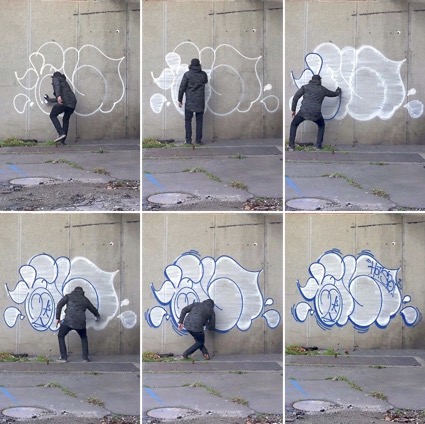
Each new act of signature tirelessly reactivates this ductus, this sequence of strokes that produces a form progressively stabilized over its occurrences. If we are regularly called upon to sign in the course of our life as a legal person, tag and throw-up differ in the intense productivity that sets up repetition as a daily gesture and makes the proliferation of names and the saturation of urban spaces the horizon of the writing act. However, the throw-up adds another specificity to this recurrence of inscriptions. At the very core of its execution, it makes the repetition of the form tracing, for the initial line and for its final outline, the very conditions of its graphic existence. Combined with the size of the inscriptions, this doubled gesticulation gives the performance a very special twist. While mastery is usually focused in the hand and wrist for tracing a signature, the whole body occupies the space for producing a throw-up. The physical performance combines a control of the flow of pressurized aerosol paint with the precision of movement, including coordination between arm sweeping and lateral leg motion. The drawing of a throw-up is a programmed contortion, even timed in certain emergency situations. The succession of strokes, one after the other, unfolds according to the rhythm of the graphic elaboration.
The graffiti buffers also act according to a ritualized movement which takes the form of a choreography (Denis and Pontille, 2021, 2024). Once on the site, they get out of their vehicle with their gaze turned towards the facades, approach the graffiti to be treated, examine it for a few seconds, take a photo, and then, while scrutinizing even more closely, they invariably reach out their hand to run their fingers over the surface several times. A perception intensifier, this haptic gesture is important in many respects. First, by touching, buffers explore the properties of both the materials of the surface and the matter of the graffiti. More precisely, they engage in what performance contracts with municipalities call the “graffitied surface”, emphasizing the material interdependencies at play that they have to deal with. Second, touch helps them to estimate the resistance of materials as well as their fragility in order to choose the appropriate tools and products at their disposal. Lastly, through such a tactile contact, they anticipate the conditions for the practical implementation of a removal technique. This systematic introductory sequence is then followed by the specific rhythm of each of the removal techniques. Let’s take a look at the two most frequently performed ones.
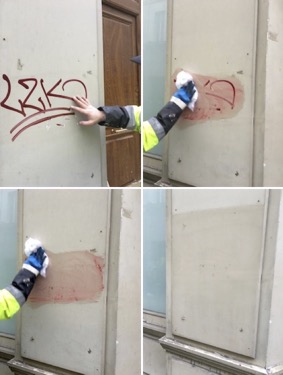
The use of chemical solvents goes hand in hand with a green scraper (a kind of dish scouring sponge) and several clean rags (figure 2). The buffers pour a small quantity of aqueous product on the scraper, coat the graffitied surface with it in small circles, and leave it to act for a short time. They carry on their circular movements without pressing on the scraper until the letters are distorted by the ink or paint that gets liquefied. They then remove the pasty mixture that has formed with a clean rag. Finally, they remove the remaining part with another clean rag, while drawing straight strips from top to bottom. The subtle proportioning of the products and the movement of the rags underline the importance of a timely coordination between the action of the heterogeneous elements and the reaction they are likely to trigger between them. Whether the action is too light or too fast and the graffiti remains, whether it is too long or too vigorous and the surface is permanently damaged.
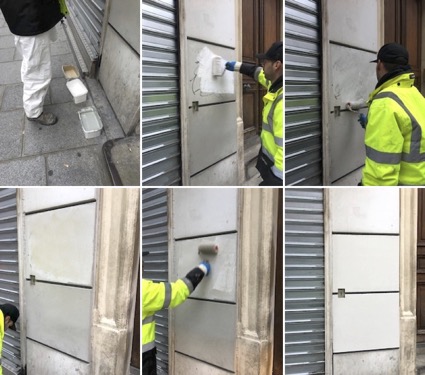
This rhythmical accuracy is also crucial for covering graffiti with paint (figure 3). During their interventions, some graffiti removers try to get as close as possible to the color of the graffitied surface. To do so, they make the blend directly on the building facade. They start by selecting the main shades needed: for example, gray, beige, and white. They then cover the graffiti with a thin layer of white, which when it starts to dry, still lets it appear in transparency. They dip the same roller still white in the gray paint pot, then immediately add small touches by tapping the roller against the surface in various places, then mixing them with the still-wet white. They start again with the beige paint by adding some touches or drawing several horizontal stripes, this time straddling the white and gray. By moving their pole with vertical movements, the three colors mix and form a homogeneous hue, which is close to that of the other parts of the facade. The balance between the layers of paint and the ballet drawn by the activation of the roller is here crucial.
The performance of graffiti writers and buffers achieves a high level of technical precision with constantly repeated movements, adjusted and refined day after day. From one iteration to another, the sequence of their movements, associated with a sophisticated mastery of their tools, follows the flow of materials towards the success of the operation: producing a throw-up that stands graphically, that is technically efficient, in a visible place; removing graffiti, while leaving as few traces as possible of the intervention itself. The aesthetics of these daily rituals is based on a choreography of gesticulations, “corporeality without mediation” which, as in dance, does not tolerate approximation (Riout, Gurdjian, Leroux, 1985: 67). In the art of graffiti and that of its buffing, any false movement is instantly visible.
Differences
The recursive gestures of graffiti writers and buffers fall within the usual definition of repetition as preparation for a performance. But this common understanding runs the risk of overlooking an essential part of their acts. For the whole point is “not to add a second and a third time to the first, but carry the first time to the ‘nth’ power” (Deleuze, 1968: 8). Repetition is a dynamic process that aims to intensify the act itself. It introduces micro-variations, stimulates the emergence of difference at the heart of the same, and engenders inescapable transformations.
Such an open conception highlights the place of iteration in the previous definition of signature (Derrida, 1982). Although its tracing by the writer’s hand is governed by a resemblance requirement, it is rid of any necessary reference to a model that would exist outside of it. Conversely, compliance from one occurrence to the next goes with inevitable latitude:
Two signatures that would be superimposable in every point would be suspicious, because it is highly unlikely that an individual can reproduce exactly the same sign twice in a row. (Fraenkel, 1992: 205)
When the perfect copy would be haunted by the work of a usurper or forger, too diligent to completely mislead their world, the authentic line, free of all suspicion, unfolds in a range of resemblances that allow for graphic variations, and must even include them.
Such a dynamic approach is particularly well illustrated by the iterations of the same throw-up that punctuate a city, street after street. While its general shape seems similar, ensuring the mandatory resemblance to designate its unique writer, it is never strictly identical. The sequence of body movements always comes with situated amplitudes: the eagerness or slowness of the gesture called for by the situation, the architectural features of the surface borders, edges, grooves or moldings, the light intensity, the level of tiredness, the ambient temperature, the quality of the solvent and the paint dispensed by the spraycans, the rough or absorbent textures, the possibility of using bricks or blocks as a guide, the stability of the ground, its inclination to a greater or lesser extent… All of these aspects are important but interfere with each other to a different intensity during each performance. Associated with one another, they incline the action in a singular direction which, from one situation to another, act to compress or stretch the throw-up. Each iteration is internally worked on and animated during its realization.
The endless cycle of interventions is therefore not a zero-sum game. It provokes inescapable alterations that graffiti writers sometimes consider as momentary mistakes to avoid, sometimes as new lines to be accentuated in their next graphic acts. These variations inevitably haunt the buffers’ action. To grasp its intensity, the usual terms, seemingly simple, are misleading: just eradicate everything and the buildings will regain their panache, successive municipal anti-graffiti policies regularly insist. However, buffing does not consist precisely in bringing the surfaces back to their supposed “initial” state (Arnold, 2019), as a phantasm of resetting their aesthetic counter. All those who have found themselves with a sheet of paper crumpled, or even perforated, after using an eraser know that erasing is a delicate matter. A technical operation, graffiti buffing sets in motion various materials, voluntarily provoking reactions between them to generate modifications. Consequently, buffers also leave minimal or fully visible traces when using their tools. Chemical solvents alter the composition of substances that become drab. High-pressure propulsion of sand or hot water abrades the materials that are dug up by the interventions. Despite a search for the right shade, paint coverages regularly produce geometrical shapes with the dimensions of the inscription. The graffiti buffers hired by the city of Paris even use a particularly colorful expression to describe the marks resulting from their interventions: they avoid producing “cleanliness stains.”
These variations have their own aesthetic regularity, to such an extent that a categorization is possible. In his experimental documentary, based on Avalon Kalin’s original concept, entitled The Subconscious Art of Graffiti Removal, Matt McCormick (2001) promoted the buffers’ productions as an art form in their own right. He elaborated a first categorization distinguishing three buffing styles. The most common, described as “symmetrical” or “conservative”, produces the geometrical shapes associated with paint covering. “Ghosting” results from the scrupulous follow-up of the graffiti outline, which then remains partly readable after the removal operation. The scarcest style, called “radical”, consists of a new shape, usually silhouettes (e.g. a cloud, a flower, an animal), made from the initial shape drawn by the graffiti writer. To these three initial styles, Matt McCormick then added the category of “redactive”, which consists of using hatching, dashes or “X” to make graffiti illegible, but partially visible. By identifying specific types of buffing, this categorization takes them out of their accidental composition in the streets and gives them an artistic significance, explicitly placed in the lineage of pieces inspired by abstract expressionism, minimalism, or Russian constructivism, such as those of Kasimir Malevitch or Mark Rothko.
Subsequently, others proposed supplements. A graphic designer and co-author of the original documentary, Avalon Kalin (2015) has introduced two new categories. “Non-removals” result from processes in building construction, such as crack priming of concrete walls or color tests on some areas of facades. “Reactionary” is produced by graffiti artists who extend the graffiti cleaning area by adding pictorial elements as false buffing traces. For their part, Stephen Burke and Fiachra Corcoran (2017), respectively plastic painter and photographer, have further refined this typology in a book entitled Buff. They notably added the “maltreated” style produced by a coarse scribble over the inscription, often with spraycan itself, and the category of “etched”, a result of the high-pressure water and sandblasting techniques that permanently alter the materials, thereby causing long-term chromatic compositions. A complementary set of categories has been subsequently published by an ex-graffiti writer as part of a series of bookzines dedicated to the streetscape (Servi, 2022).
Such a typology is heuristic to estimate graffiti removal through a new and evolving framework, which articulates graphic forms to particular techniques (figure 4). It stresses how much the interventions, aimed at the systematic eradication of graffiti, involuntarily produce chromatic assemblages endowed with some aesthetic value. However, as soon as the dynamics of the gestural iterations are reintroduced, any categorization is rapidly pushed to its extreme limit. By using corrosive solvents, permanent inks, abrasive tools, protection varnishes, and paints with high covering power, graffiti writers and buffers bring their own touches to the urban surfaces. This technological equipment stimulates the innovation of the protagonists and can be akin to a true arms race (Iveson, 2010). Above all, it underlines the intimate entanglement of performances: some go over the others, the ingenuity of the former giving rise to the inventiveness of the latter. This continuous intertwining generates achievements which, for a not insignificant part, escape any prior set of categories, no matter how fine they may be.
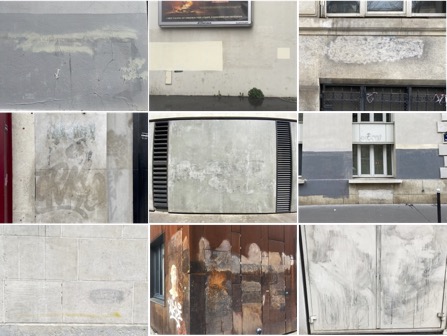
The intense pace with which some facades are targeted by interventions gives rise to fragilities that accelerate transformations. Indeed, the activity of graffiti writers and buffers continuously generates a series of entanglements of paints, solvents and other materials, just on the surfaces of the city. Ink, high-pressure water, paint and solvants migrate into the permeable and porous materials. The surfaces made of ashlar, brick, or concrete are sometimes literally worn and used out by the dance of iterations, despite their expected high resistance to weather conditions. In such cases, the stones are so deeply carved out that the surfaces cannot bear any additional intervention, or the layers of paint are so numerous that the assemblage crumbles, provokes cracks and pieces fall off. Consequently, they are officially excluded from the removal program. Not only are some urban surfaces materially transformed, but others are permanently damaged.
In parallel, this intensity is indicative of a subtle collaboration between graffiti writers and buffers, to which the owners of the graffitied surfaces sometimes contribute. A collaboration that can extend over months, or even years, to produce a large-scale mural work. In their perpetual search for new spots and compositions (Ferrell and Wiede, 2010), some graffiti writers even deliberately place their productions by adjusting them to the colorful background of the traces left by the buffers. Although the “conversation of gestures” (Mead, 1934) is part of a policy shaped in opposite terms, some of the remaining traces at the core of the struggle against graffiti amount to graphic design. The antagonism between opposing camps gives way to an asynchronous association, operating by successive contributions. In the course of this intense collaborative effort, productions with a particularly pronounced expressive radicality may even emerge momentarily. The tiny significant differences generated by the dance of iterations foster the singularity of the transformations which, as surprises at the core of the creative process, lead to unintended material and chromatic compositions.
Repeat After Me!
Although a growing number of studies have focused on the traces left by graffiti removal (Stewart and Kortright, 2015; Arnold, 2019; Andron, 2024), few have examined graffiti removal in its practicalities. And among the multiplication of “emerging research issues” (Ross et al., 2017) on graffiti, these practicalities are still overlooked. Yet focusing on graffiti removal practices offers a complementary understanding of the actual implementation of municipal policies in the streets and on facades (Denis and Pontille, 2021, 2024), while shedding light on their inevitable material part. This analytic approach also opens the investigation to the mutual interdependencies between the practices of graffiti writers and buffers, as explored here. The recursive dynamics of their respective acts highlight several dimensions that call for additional studies.
First, graffiti writers and buffers have much more in common than what is usually expected from a visual perspective focused on the traces they left behind in urban spaces. As soon as we shadow them during routine operations, their visual productions are no longer static and inert, waiting to be watched. Rather, they are tangible things in active flows that are produced on site and based on a mutual ecology of practices. Graffiti writers and buffers share language expressions (e.g. the names of local writers names, the terminology of styles, the sites and areas of the city), a peculiar form of attention (an in-depth perception of the vertical surface properties and textures, the ability to spot the exploits of their peers), gestures and postures (e.g. watching facades, touching surfaces, circulating the city), and tools and techniques (e.g. painting, making color blends, using aerosols and high-pressure projection tools, anticipating the surface reactions to their products and instruments). These common features cultivate similar skills as well as a unique knowledge of the city surfaces. Further studies may deepen this shared experience of urban verticality, apprehended as a site for action.
Second, taking the recursive dynamics of graffiti writing and removal as an analytical starting point extends the previous critics of the so-called “broken-windows” thesis (Iveson, 2009; McAuliffe and Iveson, 2011). Focused on the appearance of the social order, this thesis overemphasizes the visual perception of minor disorders and prescribes their treatment at a high rate. Consequently, the assumptions of this thesis and its critical scholars tend to overlook the material consequences of zero-tolerance policies. Although a few researchers have shown that anti-graffiti policies tend both to displace and transform graffiti rather than eradicate it (Ferrell and Weide, 2010) and to generate particular aesthetic tensions (Arnold, 2019), other material implications are at stake. Be it a form of intense competition or an asynchronous collaboration, the recursive interdependencies between graffiti writers and buffers materialize within urban surfaces beyond the sole visibility. Their “symbiotic” relationship (Shobe and Banis, 2014: 603) and “layered conversations” (Stewart and Kortright, 2015: 85) leave marks that pervade the material thickness of building facades (Chmielewska, 2007; Andron, 2024), modifying their textures and increasing their fragility. Hence, one can consider graffiti writers as defacing urban walls, whereas buffers subsequently clean them. Or one can prefer the opposite: while buffers abrade materials, carve out stones, and damage the built environment, graffiti writers care for the city by painting and giving a new aura to decaying surfaces. However, no matter which option is chosen, buffers and writers do not simply deal with surfaces as if they were already there, given in advance. Rather, they have to enact the surfaces on the spot, either a surface made of a colored, graphic design composed one, or a materially graffiti-free one. As such they contribute to the ongoing transformation of the urban fabric. Far from moving back and forth between two fixed states of surfaces (graffitied or clean), the dance of iterations is a full part of the material becoming of the city (Denis and Pontille, 2024). And this generative process is still underexplored.
Third, this recursive dynamics points to two other transformations that remain overlooked in graffiti studies. On the one hand, graffiti writing and removing are materially deep and sensitive operations. Writers and buffers carry instruments, touch surfaces, and handle products on a daily basis. Repetitive gestures and postures put a direct strain on their muscles, flesh, and bones. Bodies are severely tested and eventually suffer disorders. Body damage is also caused by regular contact with materials and exposure to products made of toxic substances. While little specialized literature exists on the occupational health of buffers (Langworth et al., 2001), there is even less about the health of graffiti writers. On the other hand, by coating surfaces or spraying products onto them, graffiti writing and removal generate residues that end up in the sewage infrastructure or the atmosphere. Besides, whatever their technical sophistication, the instruments used to write and remove consume natural resources and eventually affect the environment. Despite the recent move towards a greening of practices, driven by climate concerns and supported by some municipalities, social science investigations are scarce on these matters. Yet the urban ecologies in the making deserve a place among graffiti studies.
Whether they take the form of a smoothed dialogue moved by a shared experience, a trench warfare in performances, or a powerful unintended collaboration, the intricate relationships between graffiti writers and buffers are driven by the transformative principle of repetition. From gesture to gesture, reiteration is productive of the performance itself; it constitutes the movement that amplifies its power. This is by repetition, through it, in it, that graffiti appears and disappears continuously. It stimulates progressive variations by its successive vibrations, and takes the creative production in an unexpected direction. Repeat after me! Never manifest in its explicit form in the streets, the interpellation virtually goes along with every graffiti, tag, throw-up, or even more elaborated piece. It is as much directed towards peers and oneself, like an injunction to do better — a bigger, more colorful inscription, with more style and technical audacity —, as it is towards graffiti buffers, like a challenge thrown out as a hymn to the graphic greatness of an inscription repetition: “buff me, so that I come back immediately, both the same and totally different!”
Acknowledgments
This essay comes as a step in a long-term inquiry, conducted in close collaboration with Jérôme Denis, into the existence and maintenance of diverse urban writings (Denis and Pontille, 2012, 2014). I am very grateful to him and Marie Alauzen for providing insightful suggestions and generous feedback on a previous version. I also warmly thank every person, from graffiti removal teams in Paris to graffiti writers (a special big up to Tilt!), who agreed to share with me their experience and practical expertise, and to be shadowed during their working days.
References
Andron S. 2024. Urban Surfaces, Graffiti, and the Right to the City. London, Routledge.
Arnold E. 2019. “Aesthetics of zero tolerance”, City, vol.23(2), p. 143–169.
Artières P (2017) Policing writing in the city, 1852-1945: The invention of scriptural delinquency. In: Lyons M and Marquilhas R (eds) Approaches to the History of Written Culture: A World Inscribed. London: Springer, p. 183–201.
Austin J., 2001. Taking the train: how graffiti art became an urban crisis in New York City. New York, Columbia University Press.
Burke S., Corcoran F. 2017. Buff, Glasgow, 1815 Magazine.
Castleman C., 1982. Getting up: subway graffiti in New York, Cambridge, Mass., The MIT Press.
Chmielewska E. 2007. “Framing [con]text: graffiti and place,” Space and Culture, vol.10(2), p. 145–169.
Deleuze G. 1994. Difference and repetition, The Althone Press.
Denis J., Pontille D., 2012. “Workers of writing, materials of information,” Revue d’Anthropologie des Connaissances, vol.6(1), p. a–s.
Denis J., Pontille D., 2014. “Maintenance work and the performativity of urban inscriptions: the case of Paris subway signs”, Environment and Planning D: Society and Space, vol.32(3), p. 404–416.
Denis J., Pontille D., 2021. “Maintenance epistemology and public order: removing graffiti in Paris” Social Studies of Science, vol.51(2), p. 233–258.
Denis J., Pontille D., 2024. “The material politics of graffiti removal”, Visual Anthropology, vol.37(4), p. 354–375.
Derrida J., 1982, “Signature, event, context”, in Margins of philosophy, Chicago, The University of Chicago Press, p. 307–330.
Ehrenfeucht R. 2014. “Art, public spaces, and private property along the streets of New Orleans.” Urban Geography, vol.35(7), p. 965–979.
Ferrell J., Weide R.D., 2010, “Spot theory”, City, vol.14(1-2), p. 48–62.
Fraenkel B., 1992, La signature: genèse d’un signe, Paris, Gallimard.
Good M., 2011, Vigilante vigilante: the battle for expression, Documentary (1h26), San Francisco CA, Open Ranch Productions.
Halsey M., Young A., 2006, “‘Our desires are ungovernable’: writing graffiti in urban space”, Theoretical Criminology, vol.10(3), p. 275–306.
Iveson K., 2009, “War is over (if you want it): rethinking the graffiti problem”, Australian Planner, vol.46(4), p. 24–34.
Iveson K., 2010, “The wars on graffiti and the new military urbanism”, City, vol.14(1-2), p. 115–134.
Kalin A., 2015, One hundred and four digitally printed color photographs of graffiti-removal, Lulu Press.
Langworth S., Anundi H., Friis L., Johanson G., Lind M.-L., Söderman E., Åkesson B.A., 2001, “Acute health effects common during graffiti removal”, International Archives of Occupational and Environmental Health, vol.74(3), p. 213–218.
Mead G.H., 1934. Mind, self, society, Chicago, The University of Chicago Press.
McAuliffe C., Iveson K., 2011, “Art and crime (and other things besides … ): conceptualising graffiti in the city”, Geography Compass, vol.5(3), p. 128–143.
McCormick M. 2001, The subconscious art of graffiti removal, Experimental documentary (16 minutes), USA, Rodeo Film Company, available: youtube.com/watch?v=jmdRzqLWU_Y
Riout D., Gurdjian D., Leroux J.-P., 1985, Le livre du graffiti, Paris, Éditions Alternatives.
Rivera J., 2008, Vandal squad. Inside the New York City transit police department, 1984-2004, Brooklyn, Powerhouse Books.
Ross J.I., Bengtsen P., Lennon J.F., Phillips S., Wilson J.Z., 2017. In search of academic legitimacy: The current state of scholarship on graffiti and street art. The Social Science Journal, vol.54(4), p. 411–419.
Servi, L. (2022). Graffiti removals, Other Editions, series “the city is ours”, n°2.
Schacter R., 2008, “An ethnography of iconoclash: an investigation into the production, consumption and destruction of street-art in London”, Journal of Material Culture, vol.13(1), p. 35–61.
Shobe H., Banis D., 2014, “Zero graffiti for a beautiful city: the cultural politics of urban space in San Francisco”, Urban Geography, vol.35(4), p. 586–607.
Snyder G.J., 2009, Graffiti lives: beyond the tag in New York’s urban underground, New York: NYU Press.
Snyder G.J., 2017, “Long live the tag. Representing the foundations of graffiti”, In: Avramidis K and Tsilimpounidi M (eds), Graffiti and street art: reading, writing and representing the city, London: Routledge, p. 264-273.
Stewart M., Kortright C., 2015, “Cracks and contestation: toward an ecology of graffiti and abatement”, Visual Anthropology, vol.28(1), p. 67–87.
Stewart J., 1989, Subway Graffiti: An Aesthetic Study of Graffiti on the Subway System of New York City, 1970-1978, Ph.D. Dissertation, New York University.
Cite this Essay
Pontille, David. “The Endless Repetition of Graffiti Writing and Removing: Gestures, Sites, Traces.” Rhizomes: Cultural Studies in Emerging Knowledge, no. 41, 2026, doi:10.20415/rhiz/041.e08